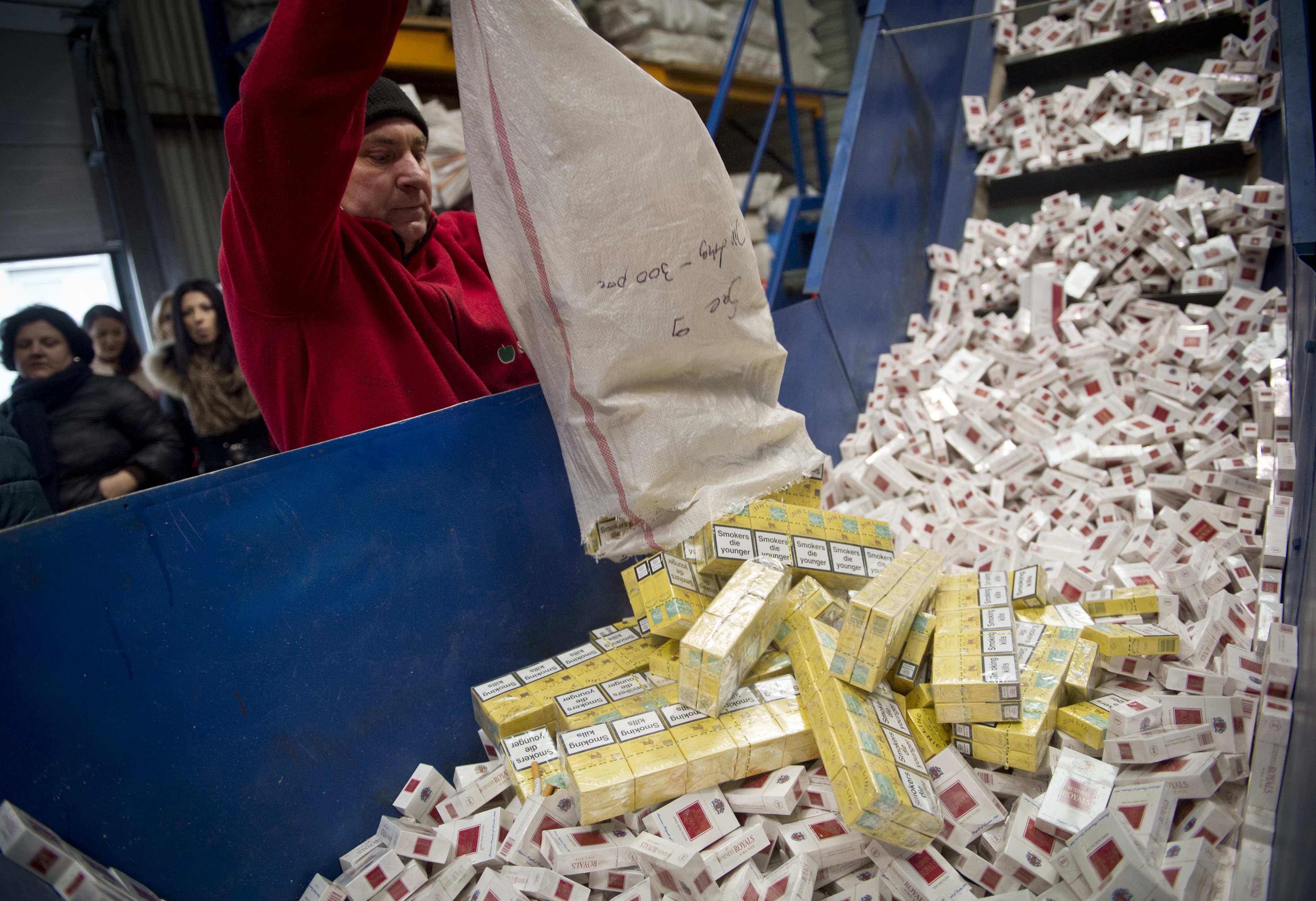
Like its peers, British American Tobacco has long presented itself as a partner in the fight against cigarette smuggling. But new research into company documents leaked years ago suggests its efforts to combat the black market served a different purpose: creating commercial opportunities, targeting competitors and influencing government policy.
The research was conducted by the University of Bath’s Tobacco Control Research Group in the United Kingdom, which in 2013 and 2014 received about 15,000 documents from a former BAT employee who had worked on the company’s anti-illicit trade team across the Horn of Africa from about 2000 to 2014. Among those documents were dozens offering a rare look inside BAT’s effort to tackle illegal cigarette sales.
Subscribe to our newsletter
Global health reporting, straight to your inbox
This month, researchers Benoît Gomis and Allen Gallagher published two studies concluding that BAT officials appeared reluctant to intervene when the company’s cigarettes were sold illicitly, and that they used anti-smuggling operations to pursue commercial advantage. The researchers said their findings indicate British American Tobacco’s anti-smuggling efforts were focused on increasing its own sales and gaining access to policymakers rather than eliminating illicit trade.
BAT did not respond to a request for comment from The Examination, but it has previously said it "emphatically rejects mischaracterisation" of its anti-illicit trade activities, and that "acting responsibly and with integrity underpins the foundations of our culture and values as a company.”
The Examination spoke to Gomis and Gallagher about what the documents revealed about BAT’s past operations and what their findings mean for governments considering tougher tobacco controls. This interview has been edited for clarity and length.
What does your research reveal about British American Tobacco's anti-smuggling program during this period?
Benoît Gomis: What's wrong with a company who wants to partner with authorities and address illicit trade, right? I presume we all want responsible companies who are working towards the greater good. Except in this case, we found evidence indicating that BAT had in fact remained involved in illicit trade while portraying itself as part of the solution.
Allen Gallagher: Our evidence is suggesting that BAT covered up indications its own products appeared illegally in various markets, and ultimately it was only trying to tackle illicit trade when it felt it would financially benefit from doing so. Ultimately, BAT was using its anti-illicit trade program to boost its reputation and try to gain a seat at the policymaking table to push for lower regulation and taxation.
Researchers and journalists have previously examined BAT's links to smuggling, including the “BAT Uncovered” reports put out by your groups and others about Southern Africa. What does this research add?
Gallagher: This is broader in terms of covering a larger geographical area, so East and Central Africa as well as parts of the Middle East. It includes the makeup, structure and breakdown of what the anti-illicit trade team were up to day to day.
Gomis: What's interesting with the new evidence is that BAT continued to use strategies that tobacco companies previously faced legal action for in the late ’90s and early 2000s, including relying on distributors linked to smuggling.
What's also new is we found internal memos indicating that company officials went out of their way to avoid interventions by authorities even though they were technically cooperating with many of them. And the point of those illicit trade agreements was to bring more transparency across tobacco products supply chains, not less.
You concluded BAT’s anti-smuggling efforts weren't actually about stopping smuggling. What was the strongest evidence?
Gomis: We have found memos pointing to BAT's AIT (anti-illicit trade) activities as being there to create “contestable space,” which BAT defined as “the theoretical maximum opportunity available in each segment.” In other words, by going after competitors and working with authorities, BAT would create a gap in the market, which the company would then be able to fill with more of their own sales.
In Ethiopia in 2013, there was a memo which showed that BAT was unwilling to reduce the so-called diversion of its own cigarettes to illicit trade because the company was not set up to fill that gap with its own legal products. There's a quote in there that “any AIT operations would only be creating contestable space for either PMI [Philip Morris International] or the illicit trader.”
It's such an interesting memo and in a stark contrast with what the company had been claiming publicly.
One of your papers suggested that BAT could have been complicit in smuggling cigarettes. Is that correct?
Gomis: Let's start with what's already publicly available. In 2023, BAT paid fines of over $629 million following an investigation by U.S. authorities for sanctions evasion in North Korea. In 2007, BAT publicly stated it was no longer doing business in North Korea, but U.S. authorities uncovered a smuggling scheme whereby BAT continued distributing cigarettes into the country for at least a decade through its subsidiary in Singapore and through a longtime distributor, Singapura United Trading Limited.
One of the interesting things about this case is that Singapura United Trading is also listed in our batch of internal BAT documents. Singapura United Trading basically appointed a company to distribute BAT duty-free products to Mongolia. And other internal documents found several instances of those products being diverted to the United Arab Emirates and Iraq illegally, but BAT's global head of trade decided to retain both Singapura United Trading and that distributor despite those links to illegal diversion.
Your research also talked about the concept of security companies being used by BAT as a “buffer” between its staff and dubious practices. Can you talk a bit more about that?
Gallagher: Very small security companies would be carrying out activities on behalf of BAT, which involved looking at competitors' involvement in illicit trade, picking their targets and actually trying to co-opt enforcement bodies to help them eliminate competitors. We found evidence around how dubious their methods were in terms of putting in place a fake trade union at a competitor’s factory and widespread use of informants to disrupt competitors’ production. The motivations were about their profit rather than health. The BAT documents describe these security providers as “providing a buffer/cut-out between BAT staff and illicit traders.”
Can you explain how the tobacco industry as a whole uses the specter of illicit trade to fight cigarette regulations and taxes?
Gomis: This is a big part of the Big Tobacco playbook. You see tobacco companies basically funding research routinely exaggerating the scale of illicit trade. This research oversimplifies the links between regulation or high taxes, on the one hand, and illicit trade on the other. Tobacco companies can then use all of that research when lobbying authorities directly or indirectly.
But research shows that countries with higher levels of tobacco taxation and regulation tend to have lower levels of illicit trade, in part because of greater institutional capacity to deal with the issue, and also because they've been able to more effectively reduce all smoking of legal and illegal cigarettes.
Gallagher: The threat of illicit trade is one of the most common arguments made in opposition to virtually every tobacco control policy that has ever been proposed or implemented by a government.
Gomis: That's not to dismiss the threat and the existence of illicit trade. It is an issue that we need to take into consideration. But it's something for which we need to put in place sound, industry-independent policies and interventions rather than simply having that void filled by tobacco companies and other forces.
The U.K.'s generational tobacco sales ban will take effect next year, and we're seeing a lot of commentary about how prohibition will fuel the black market. How do you think policymakers should weigh that warning against the findings of your research?
Gallagher: The reality is that arguments about this U.K. act fueling illicit trade are speculative and they're not grounded in evidence. When the age of sale increased from 16 to 18 in the U.K. in 2007, illicit cigarette consumption fell by 25%.
Gomis: Most misinformation and disinformation attempts contain some modicum of truth. It is true that liquor prohibition in the U.S. led to an increase in illicit trade and organized crime. And that's certainly an argument and a historical example that tobacco companies have continued to stress. But in that case, it's important to look back into that history and recognize that a lot of the problems back then were actually caused by licensed alcohol manufacturers, distilleries and distributors continuing to operate despite that ban and even smuggling products from Canada.
That’s similar to tobacco products. The majority of cigarettes in illegal markets worldwide are in fact legally manufactured by licensed tobacco companies and later on diverted to the illegal market.
Tobacco companies argue that it's better for smokers to buy from regulated companies than to buy counterfeit, black market cigarettes that could be more harmful. How would you respond?
Gomis: It is another major misconception. Legal cigarettes are an extremely deadly product. Cigarettes kill between one-half and two-thirds of its users; smoking is the leading cause of preventable disease and death around the world.
It is true that a small part of the illegal market is made up of counterfeit cigarettes. The manufacturing process for counterfeit cigarettes is perhaps even less controlled than the legal manufacturing process. But the level of harm is incredibly high either way.
Gallagher: From a broader societal perspective, I guess one benefit to purchasing legally is that by paying appropriate taxes, you're creating government revenue that can go toward funding public services, whereas profits from illicit sales can fund organized crime. In both cases, you're giving money to actors profiting from addiction, disease and death.
The industry positions its crackdowns on smuggling as beneficial for public health because the availability of cheap cigarettes on the black market prevents people from quitting. Is there any evidence that tobacco companies’ anti-illicit trade programs have aided public health efforts, such as by reducing the number of smokers?
Gallagher: There has not been evidence of these actually being effective.
Gomis: Anti-illicit trade programs run by tobacco companies are part of their renormalization strategy to rebrand themselves into partners of governments working for the greater good.
Our research into BAT has shown how much of a contrast there was between their public claims and what they were actually doing in practice.
The goal was not public health; it was not really even eliminating illicit trade. It was just to create more commercial opportunities for the company in addition to all the policy and reputation objectives.
The University of Bath’s Tobacco Control Research Group receives funding from Bloomberg Philanthropies, which also provides financial support to The Examination. The Examination operates independently and is solely responsible for its content.