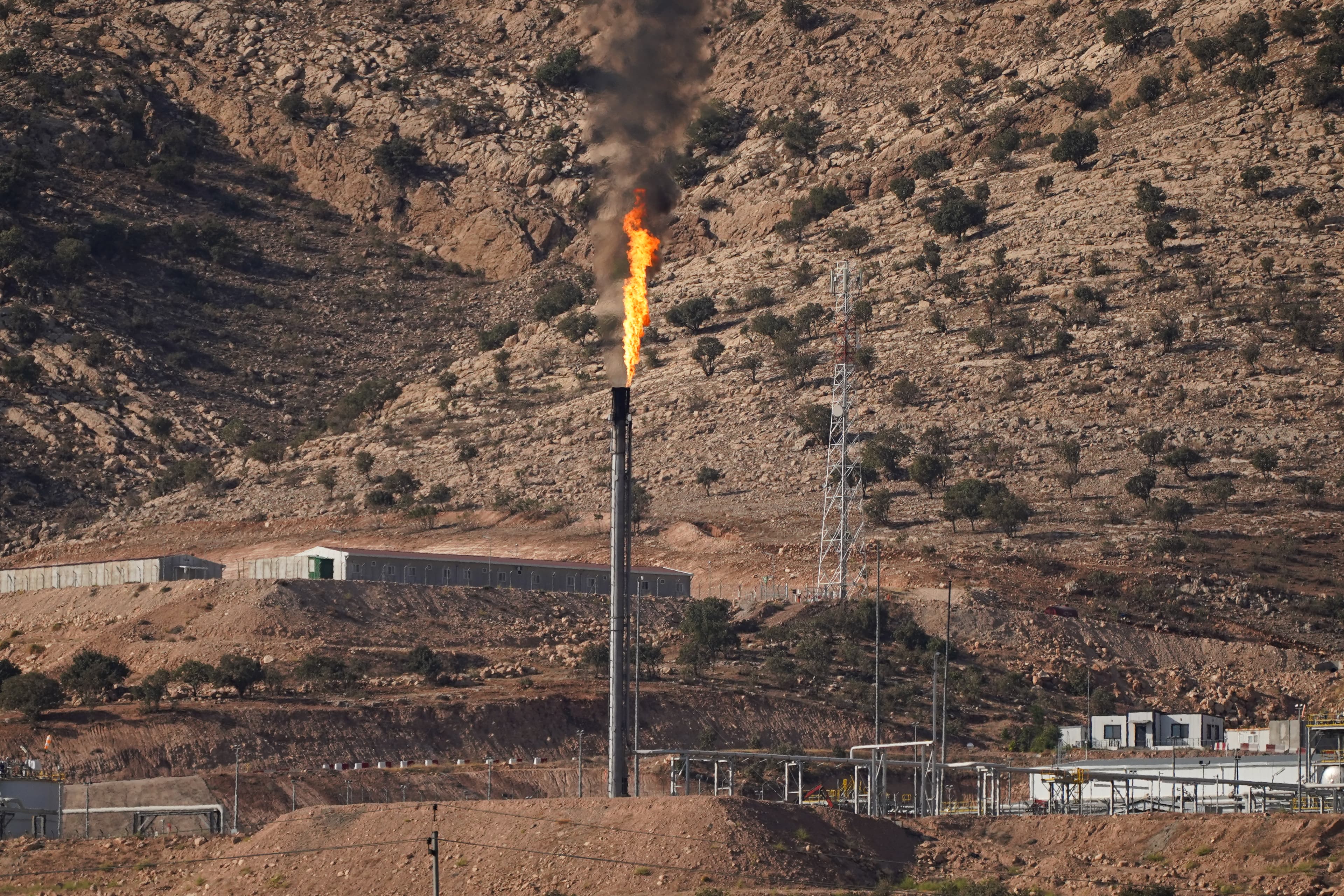
The oil industry’s practice of flaring gas from production facilities, which spews toxic emissions into nearby communities and contributes to climate change, has gotten worse, according to a new World Bank report.
Looming over oil fields like giant torches, flares burn off the gas that is pulled to the surface along with oil. Despite longstanding, industry-backed efforts to reduce flaring, the World Bank found that the volume of gas flared worldwide went up last year for the third year in a row. The amount burned, 167 billion cubic meters, is about as much as all the natural gas consumed in Africa — and was 16% higher than in 2012.
“We are moving in the wrong direction, and the scale of natural resource waste and economic loss is staggering,” the World Bank stated in its report.
Oil companies could reduce flaring by capturing the gas and processing it for sale or reinjecting it underground. But companies and governments have failed to prioritize such solutions, resulting in a lack of investment and regulation, the World Bank said.
Nine countries — Russia, Iran, Iraq, Venezuela, Mexico, Libya, Algeria, Nigeria and the United States — accounted for most of the flaring around the globe last year.
Flaring pollutes the air with soot, sulfur dioxide, nitrogen oxides and other harmful substances. Research has linked flaring to negative health effects such as preterm births and hospitalizations for respiratory problems. A study published this year found a connection between flaring and respiratory diseases and fever among children under the age of 5 in Nigeria, which ranks eighth among top-flaring countries.
Subscribe to our newsletter
Global health reporting, straight to your inbox
Flaring in that country increased by 8% last year, according to the report. Nnimmo Bassey, director of the Health of Mother Earth Foundation, which works with Niger Delta communities to curb flaring, said he’s noticed the increase.
Some flares have been burning for decades and the health impacts are well known, he said. People who live near flares complain of respiratory problems and cancer. Some live so close to flares that they have had to abandon their homes due to the heat.
“These flares are massive furnaces, where the flames are lifting up several meters in the air, and burning with terrific noise and terrific heat,” Bassey said. “It’s very traumatic for the people. It’s a disaster.”
The carbon dioxide emissions from burning gas, and the methane that leaks from inefficient or unlit flares, have a significant climate impact. The increase in flaring from 2024 to 2025 alone resulted in as much carbon pollution as 5 million additional gasoline-powered cars, the World Bank estimated.
These flares are massive furnaces. … It’s very traumatic for the people.
Nnimmo Bassey, director of the Health of Mother Earth Foundation in Nigeria
Progress is still possible, the World Bank emphasized. The United States decreased flaring last year, in part because a new pipeline enabled more gas to be shipped from Texas’ Permian Basin. And Kazakhstan continued to cut flaring through regulations such as a requirement that companies use the best available technologies at sites with large flares.
But those gains were overshadowed by greater flaring in countries such as Russia, Mexico and Iran. Big reductions in high-flaring countries could move the needle, the World Bank said, but “the time for incremental progress has passed.”
One of the biggest increases came in Mexico, where a study last year reported a link between flaring and health problems in newborns. Mexico’s national oil company Pemex faces indebtedness, aging infrastructure and declining sales, which make investing in solutions difficult, the World Bank report said.
Pemex, the International Association of Oil & Gas Producers and the American Petroleum Institute did not respond to The Examination’s requests for comment.
Flaring releases air pollutants associated with heart disease, asthma and cancer, said Jill Johnston, associate professor of environmental and occupational health at the University of California, Irvine. She co-authored a study that found pregnant women living near flares had 50% higher odds of preterm birth, which can lead to health problems for the babies.
“As there’s more flaring, there’s likely going to be increased risk,” she said. “It’s not good news.”