
Globally, just a handful of countries and U.S. states have tried to introduce laws to ban future generations from ever smoking. So far, the only jurisdictions to succeed are the tiny Indian Ocean nation of the Maldives and 22 towns in Massachusetts.
Such generational bans make it illegal for anyone born after a certain date to ever buy tobacco. In the U.K., a proposal last year was derailed after a change in government, though it may yet become law. Previous efforts in New Zealand, Malaysia, Indiana and Hawaii failed to pass or were dropped amid opposition from the tobacco industry.
So how did an anti-tobacco measure defeated in multiple regions gain traction in New England? In part, by pressing the case before the most local form of government.
The movement began in the city of Brookline, Massachusetts, which in 2020 passed a law banning anyone born this century from buying tobacco. A convenience store owners’ group challenged the law in court, arguing that it conflicted with a law setting the age to purchase at 21 and that it unconstitutionally discriminated against those born on or after Jan. 1, 2000.
But after the state’s highest court ruled for Brookline in 2024, a grassroots effort spread similar laws to 21 other towns. More than 600,000 people now live under such bans.
Central to the effort to pass these laws is Maureen Buzby. Now 78, she spent 38 years in corporate finance before retiring and volunteering for a local substance abuse prevention group. That led to a job as a tobacco prevention official covering several towns in the Boston suburbs, where the day-to-day work includes running sting operations in which trained teenagers attempt to illegally buy tobacco.
600,000
People live in Massachusetts towns and cities where people born after certain dates are barred from purchasing tobacco and nicotine products for their entire lives
After Brookline’s ban was upheld in court, Buzby persuaded health boards in six towns where she conducted tobacco inspections to outlaw nicotine sales to anyone born from Jan. 1, 2004, onwards. She became a driving force in a group of eight volunteers, including a lawyer, a retired doctor and a scientist, who spend their free time lobbying health boards across the state.
The laws she’s worked to pass in Massachusetts go further than the generational ban proposed in the U.K., which would apply only to tobacco products. The municipalities’ laws cover all non-medical nicotine products, including vapes and pouches.
Buzby said she’s driven by a long memory of new nicotine products introduced over the years: from “pink and purple foil-wrapped, flavored cigarillos that looked like candy and cost just 69 or 79 cents, to newer vapes that look like toys, play music and have video games, to nicotine pouches — high in nicotine content, very, very discrete, and extremely cheap.”
The tobacco industry needs new customers, she said. “Those customers are our children.”
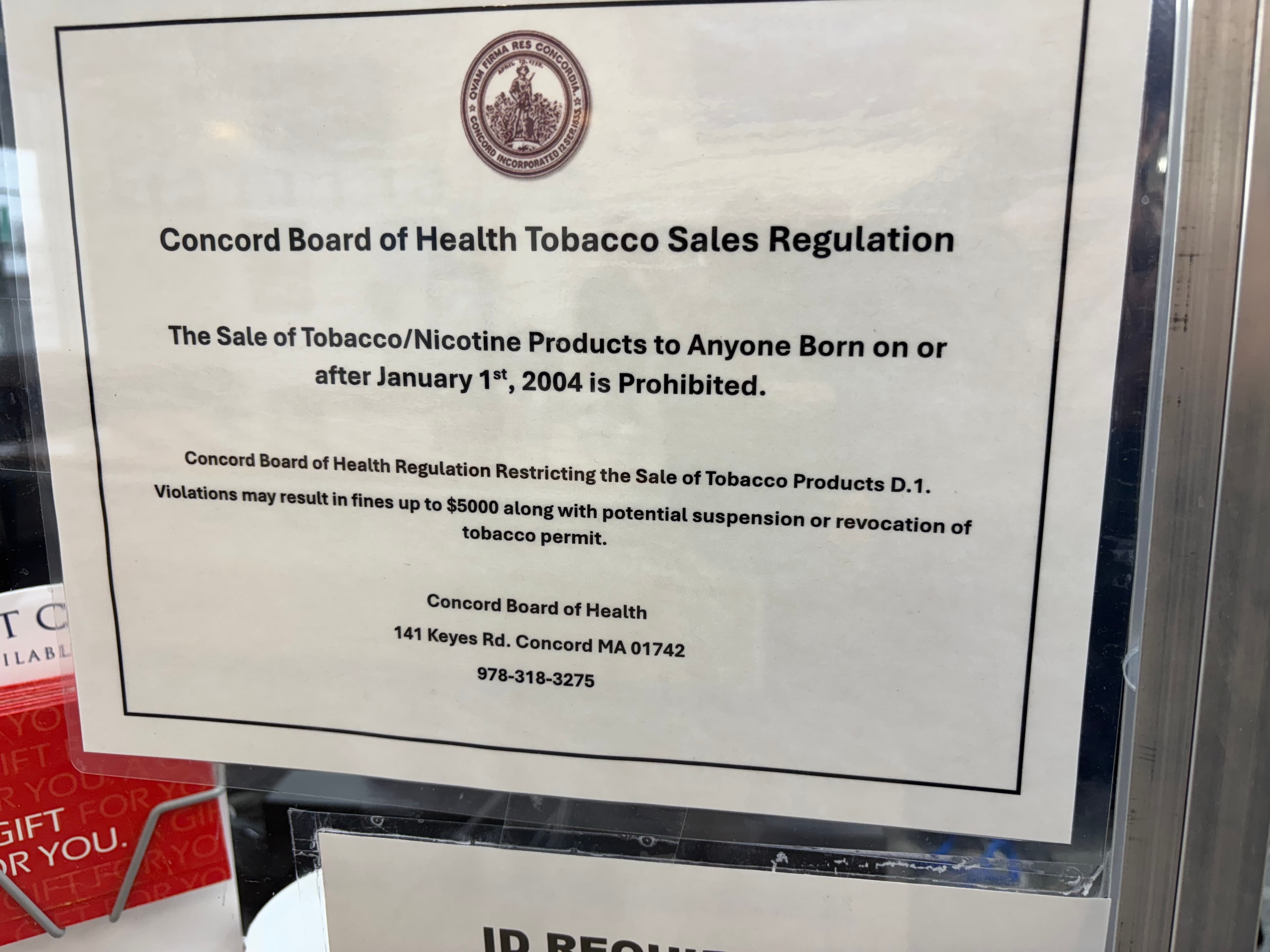
The campaign has worked in part due to a quirk of Massachusetts law: Local governments can set many of their own public health policies. In many municipalities, that power has been handed to health boards made up of elected officials or appointed volunteers, often people with medical backgrounds who are paid a small stipend to meet in drafty municipal buildings. These boards, small and numerous, are difficult targets for industry lobbyists.
But their efforts to rein in nicotine products have gotten the attention of industry-friendly groups including the New England Convenience Store and Energy Marketers Association. The trade group lists tobacco giants Altria, Reynolds American and ITG Brands as sponsors of its events, and it has made arguments against generational bans similar to those made by tobacco companies.
The group has helped defeat generational bans in a number of Massachusetts towns, including most recently, the Cape Cod beach hub of Barnstable.
“This is a bad policy that violates adult civil liberties and tramples on the democratic process,” said Peter Brennan, the group’s executive director, in an email. Nicotine products “are legal for adults to purchase and should remain in licensed, regulated establishments where they can best be kept out of the hands of those under the legal age of purchase.”
Buzby has heard some of those arguments from business owners at public meetings. Privately, she said, they say something else. “Many tobacco retailers tell me they don’t want their kids smoking. They wish they didn’t have to sell these products,” she said. “They only do it because the store next door sells it.”
Subscribe to our newsletter
Global health reporting, straight to your inbox
Such bans face higher legal hurdles in some parts of the country. In a dozen U.S. states, including Washington and New Hampshire, state law preemptively bars local governments from enacting certain anti-tobacco measures.
But in states where municipal bans aren’t pre-empted, local governments can pass generational bans or other policies to phase out smoking, said Megan Manning, a spokesperson for Action on Smoking and Health, an anti-tobacco group. She acknowledged that passing laws through individual city councils could be slow going.
In California, Beverly Hills and three other wealthy enclaves have passed laws that go even further than generational bans and outlaw the sale of all nicotine products. Local governments in Minnesota and New York have passed laws that will reduce the number of tobacco retail licenses to zero over time, making it harder and harder to buy these products over the counter.
Passing laws at the local level has allowed Massachusetts to break new ground when it comes to tobacco control. In 1994, Brookline was among the first jurisdictions in the country to ban smoking in most indoor public places. In 2005, the Boston suburb of Needham became the first municipality in the nation to raise the age to buy tobacco to 21 — which became federal law in 2019. Bans on menthol cigarettes in Boston and two neighboring cities in 2016 foreshadowed a statewide ban.
Now, a generational ban bill is before the state legislature. Buzby said it probably will take two or three legislative sessions to get enough support to pass the bill. In the meantime, she wants to ensure “that the state legislature takes a serious look” at the bill — by convincing more cities and towns to enact bans. “It’s a long game.”