This story was reported in collaboration with POLITICO.
When the world’s largest tobacco company needed help lifting international restrictions on its products, it enlisted an unlikely ally: the European Union, a leader in tobacco control.
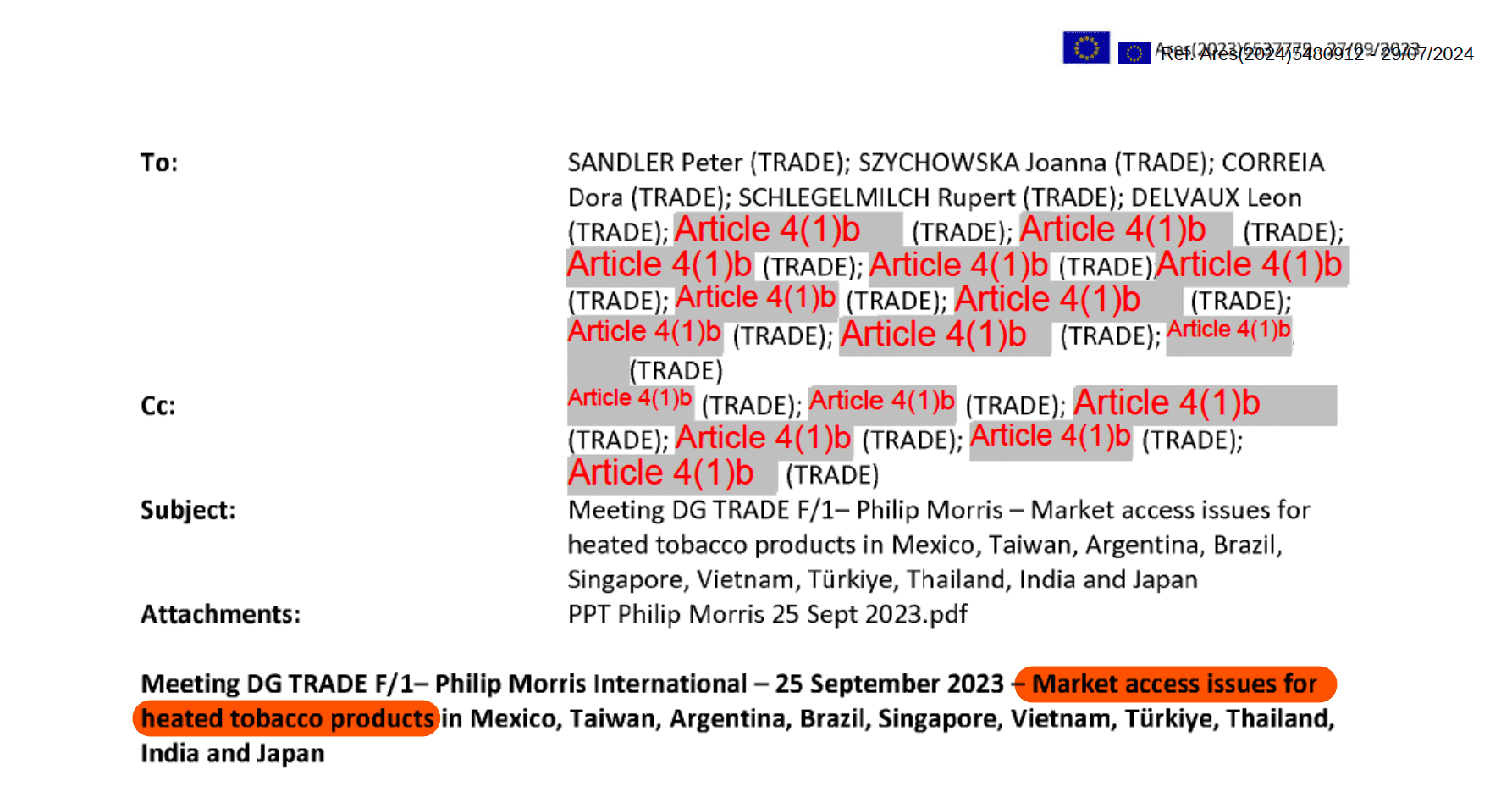
EU officials met with Philip Morris International representatives at least six times from September 2022 through 2024, according to documents released through public records requests.
The tobacco giant’s agenda: Enlist EU officials’ help in loosening restrictions or setting favorable tax rates on its products — including IQOS, a heated tobacco device key to the company’s future — in 10 countries outside the EU.
Officials with the European Commission, the EU’s executive arm, took action at least three times that would have benefitted the company, The Examination and POLITICO found. They published a notice saying Mexico’s ban on new nicotine products was a possible barrier to free trade. They asked Turkish officials whether they planned to maintain the country’s requirement that cigarettes contain a minimum amount of local tobacco. And in a high-level report for EU officials, they flagged that rule and Turkey’s cigarette tax rate as issues that could affect ties between it and the EU.
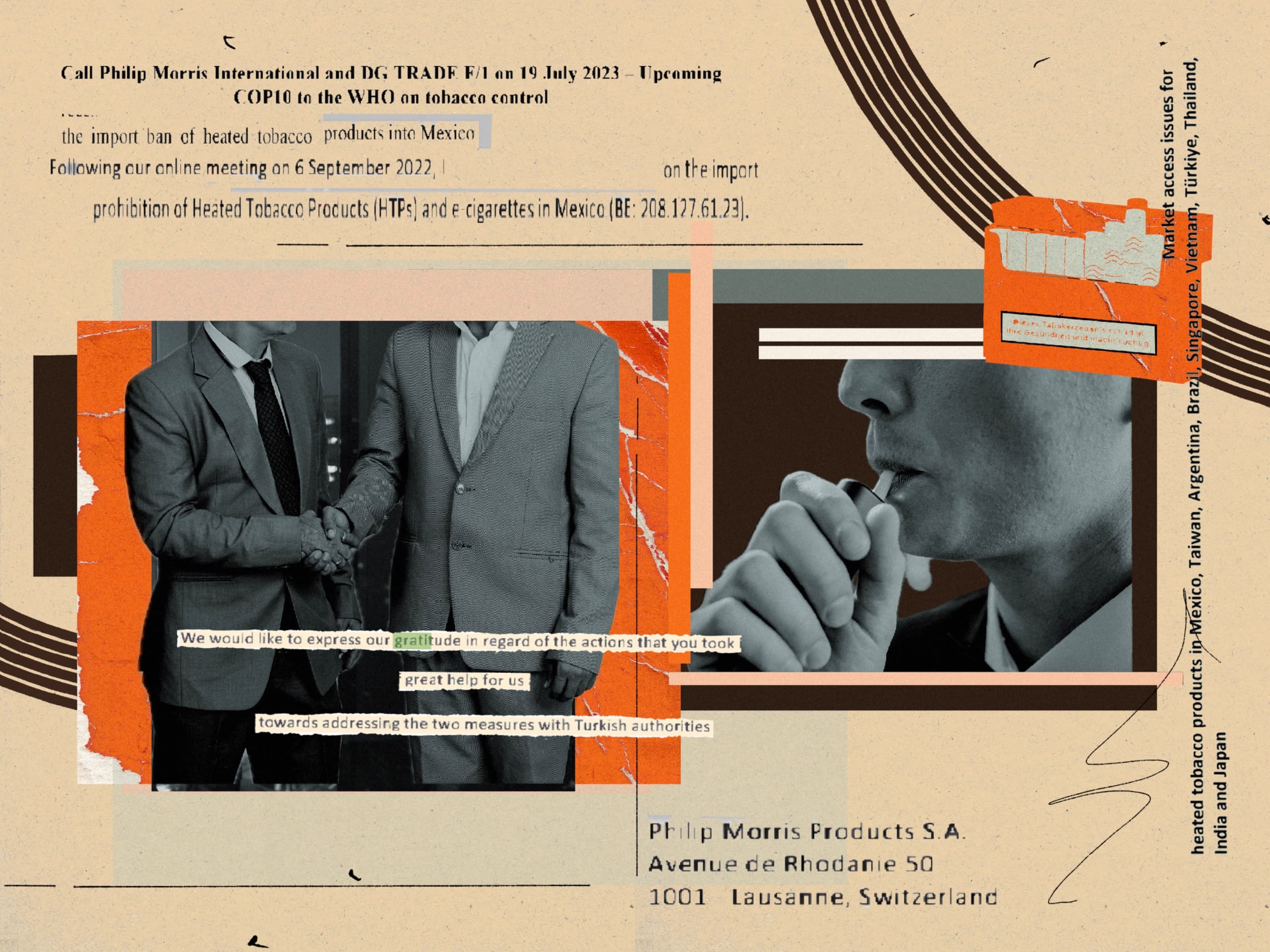
The Commission’s actions regarding Turkey were “of great help for us,” a Philip Morris International representative wrote to staffers at the Commission. “We would like to express our gratitude in regard of the actions that you took.”
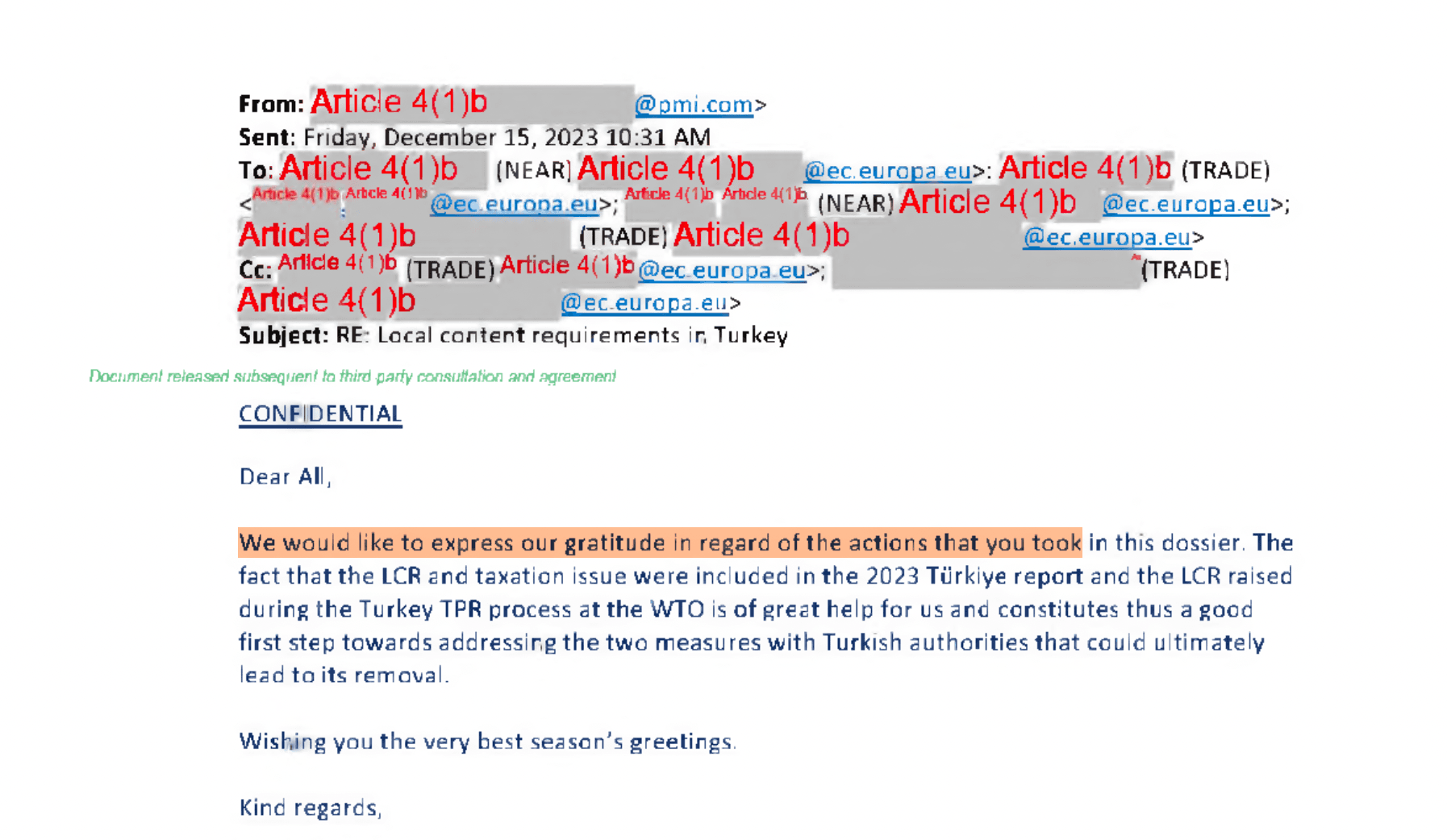
The revelations, contained in documents released through public information requests by the French anti-tobacco group Contre-Feu, raise questions about whether the EU breached its commitment to a global treaty to combat smoking signed by the EU and member countries.
Guidelines to implement that treaty — the Framework Convention on Tobacco Control (FCTC) — say that when setting and implementing public health policies, governments should restrict their dealings with the tobacco industry and disclose any meetings whenever possible. None of the meetings with Philip Morris International or other industry groups cited in the documents were disclosed, according to The Examination and POLITICO’s review of the EU’s disclosure websites.
The “fact that EU officials acted upon PMI’s requests signals a troubling willingness to give the tobacco industry privileged access. That is precisely what the FCTC was designed to prevent,” said Tilly Metz, a member of the European Parliament with the Green Party. “It undermines both public trust and the EU’s credibility as a global leader in tobacco control.”
We would like to express our gratitude in regard of the actions that you took.
Philip Morris International representative
A spokesperson for the European Commission told The Examination and POLITICO that it “strictly follows” the treaty guidelines. But tobacco products are covered by EU trade policy, and the Commission can negotiate tariffs and trade rules, the spokesperson said.
“The Commission does not shape, influence or lobby for specific health policies in third countries on behalf of any industry,” the spokesperson said.
While industry associations and companies can share concerns on market access in non-EU countries with the Commission, and the Commission may meet with complainants to get more information, the spokesperson said such meetings are "strictly related to trade facilitation and market access.”
Members of the European Parliament appeared divided over whether the dealings were improper.
Vytenis Andriukaitis with the Socialists and Democrats and a former EU health commissioner said the European Commission “cannot represent the interests of tobacco companies,” nor “press other countries to weaken” their tobacco controls.
Barry Andrews, a member of the centrist Renew Europe Group, said: “These regular meetings with big tobacco lobbyists and the flurry of emails should not have happened.” By contrast, Stine Bosse, a member of the same political group, said, "the tobacco industry has every right to employ lobbyists.”
However, Bosse added: “Morally, I stand in a very different place. While they constantly try to reinvent new products to get people hooked on nicotine and tobacco, I am fighting for precisely the opposite.”
Philip Morris International did not answer questions from The Examination and POLITICO about its dealing with EU officials. On its website, the company said it shares its perspectives with policymakers and it is “particularly active with respect to policies regarding less harmful alternatives to cigarettes, trade and fiscal matters, and intellectual property.” (The company is separate from Philip Morris USA, which is part of Altria Group.)
The Examination and POLITICO have not found evidence that any of the 10 countries targeted by Philip Morris International altered their tobacco taxes or regulations following meetings with EU officials, including where the EU took action with regard to Mexico and Turkey.
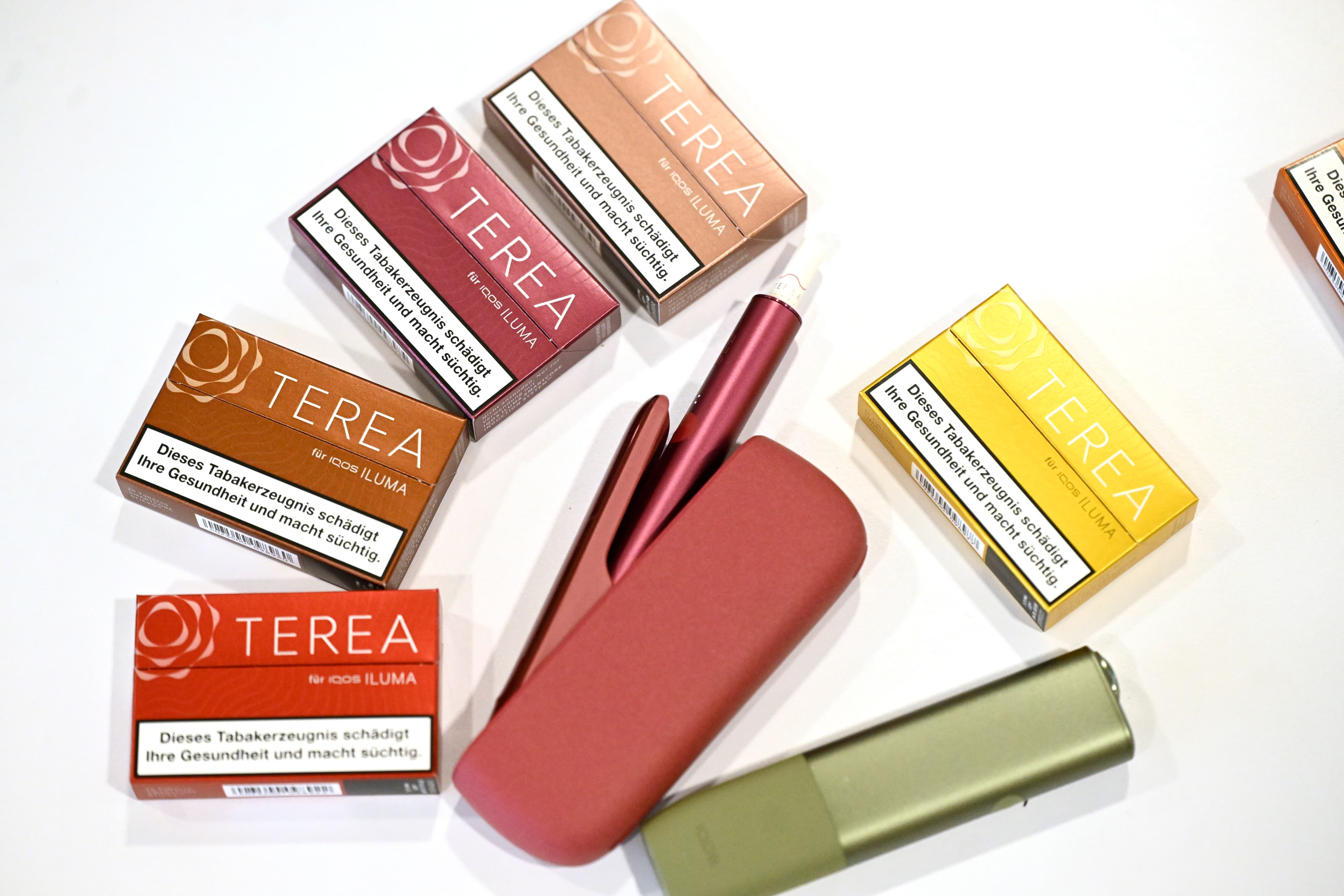
Most of Philip Morris International’s entreaties focused on IQOS, which it says is better than cigarettes because heating tobacco releases fewer toxins than burning it. Public health experts say the long-term risks of heated tobacco are unknown and products like IQOS could increase tobacco use.
Public health advocates said Commission officials’ actions were especially surprising because the EU has been one of the strongest supporters of the global tobacco treaty.
This year, the Commission proposed hiking EU-wide taxes on most tobacco products and setting minimum taxes for vapes and heated tobacco for the first time. Health Commissioner Olivér Várhelyi has pledged to drive e-cigarette taxes even higher; his tax counterpart, Wopke Hoekstra, has called vapes the “revenge of the tobacco industry.”
The countries that Philip Morris International sought help with were outside the EU. Nearly all of them — Argentina, Brazil, India, Mexico, Singapore, Thailand, Turkey and Vietnam — had banned heated tobacco. Taiwan had what the company described as a burdensome approval process. Japanese leaders were in discussions to raise taxes on heated tobacco to the same rate as cigarettes.
Philip Morris International officials wanted people in those countries to be able to buy IQOS as easily as cigarettes. The company calls IQOS part of its “dream team” of alternative nicotine products, including e-cigarettes and nicotine pouches, that are meant to offset declining cigarette consumption.
So the company sought help in the EU’s distinctive, 15-story glass trade building, the Charlemagne, in Brussels.
Philip Morris International seeks help fighting limits on heated tobacco in Mexico
Mexico was the first country that Philip Morris International sought help with, according to the documents.
That country was a key market for IQOS, but a ban on vapes and heated tobacco was set to go into effect in December 2022.
In an investor meeting on Sept. 6, 2022, an analyst asked about IQOS’ “lack of success” in the Americas. Emmanuel Babeau, the company’s chief financial officer, blamed “some restrictions” in Mexico but said, “it's going to be a very successful market for IQOS once we can really sell the device really without any issue.”
That same day, company staff had an online meeting with EU officials to discuss the ban. It was one of several discussions about Mexico.
After the ban went into effect, Philip Morris International sought more help from EU officials. In an April 3, 2023, email, an executive at the company’s Swiss office asked for another meeting, explaining that Mexico’s “business environment is still marked by uncertainty, judicial processes, interpretations, and doubtful, temporary and unclear administrative acts.”
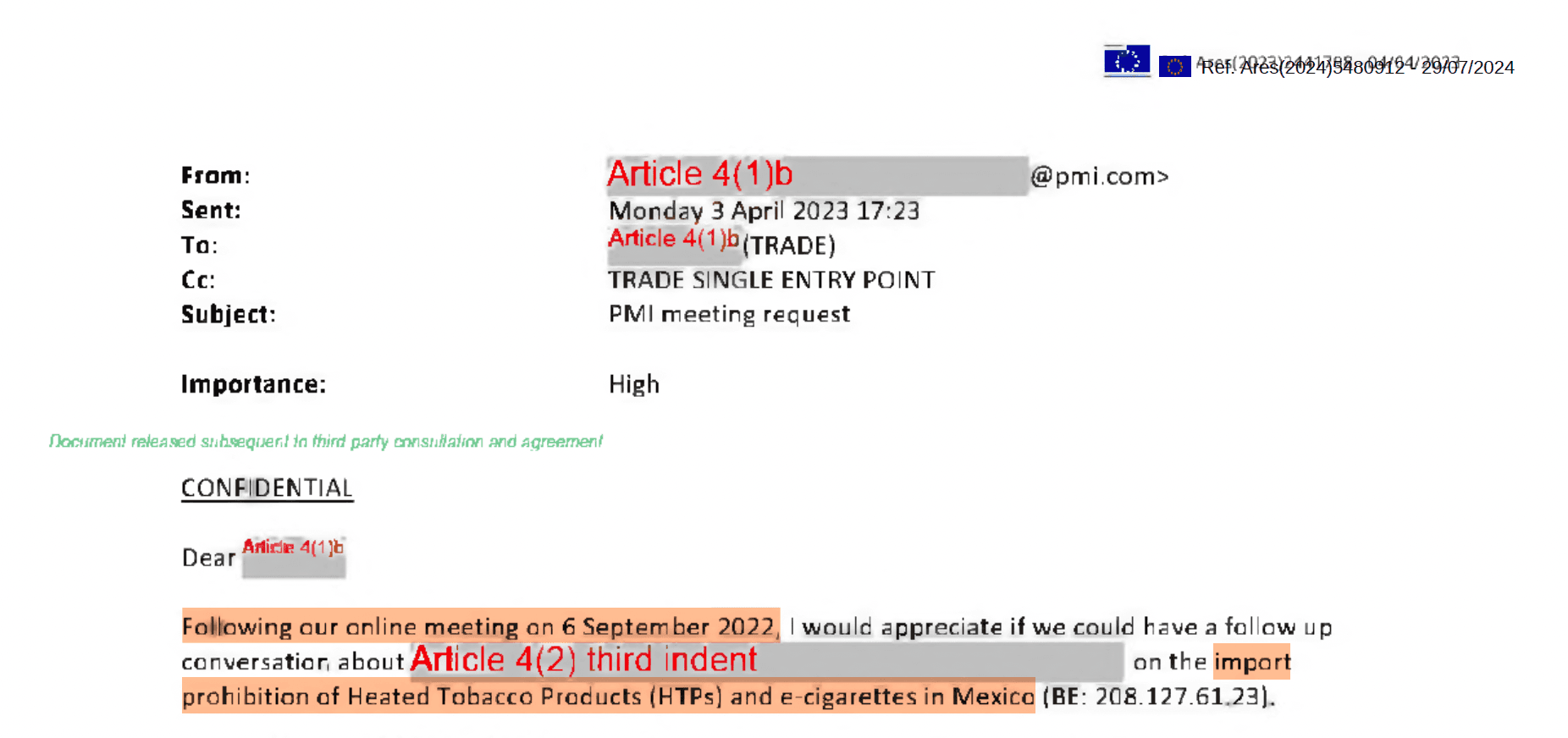
Soon after the email, European trade officials issued what is known as a barrier to trade notice, reporting Mexico’s IQOS ban as a potential trade treaty violation. Philip Morris International representatives and trade officials met later that month, when the company contended similar bans in Argentina, Brazil and Vietnam were trade barriers, according to a Commission report summarizing the meeting.
The Commission spokesperson said it had acted in response to a formal complaint that “involved discriminatory treatment of like products” and that it did not undertake any further action regarding Mexico.
Subscribe to our newsletter
Global health reporting, straight to your inbox
Mexico’s Supreme Court struck down the ban in November 2024, allowing Philip Morris International to continue selling IQOS there.
The correspondence shows how Philip Morris International leveraged its status as a major European employer and exporter. The company employed more than 21,500 people in Europe as of 2023 and had 20 manufacturing sites there.
In one email, a Philip Morris International representative told a European trade official that a meeting would be a “good opportunity to update you [on] the most recent data on EU exports in the tobacco sector and PMI’s investments in the EU.”
Officials question Turkey’s taxes, rules on local tobacco
EU officials also assisted Philip Morris International in trying to change rules on cigarettes.
In July 2023, a company representative complained to EU officials about Turkey’s cigarette tax, saying in an email that Turkey had “one of the highest ad valorem duty levels in the world.”
The representative also flagged Turkey’s “local content” rule, which required that cigarettes made and sold in the country contain a certain amount of domestic tobacco.
The Philip Morris International representative wrote that the company had “prepared a few suggestions” for the Commission’s upcoming report on Turkey’s economic and diplomatic relationships with the EU.
That report, which came out in November 2023, flagged Turkey’s taxes and the local content rule. That elicited the email from Philip Morris International thanking EU officials for their help.
Meanwhile, the company was pushing European Commission officials to raise the local content rule again, but in a different forum: an upcoming World Trade Organization (WTO) review of Turkey’s trade policies.
Philip Morris International provided EU trade officials with questions to ask Turkey. EU officials then submitted a question prior to the review, asking whether the local content requirement for tobacco and other industries would continue, according to meeting minutes. The Commission spokesperson did not directly answer questions from The Examination and POLITICO about its actions regarding Turkey.
Turkey has not changed its requirements on local tobacco or its tax rate.
Meetings part of a multimillion-dollar lobbying effort
The meetings are part of an industry lobby that spends $16.2 million (14 million euros) a year in the EU, according to a report by Contre-Feu and STOP, another anti-tobacco group, released Wednesday.
Contre-Feu mapped a network of 49 organizations and companies, including Philip Morris International and British American Tobacco, that lobbied the European Commission and Parliament to weaken tobacco regulations and set lower taxes on new nicotine products, both within and outside the EU. (British American Tobacco did not respond to requests for comment.)
The interactions between the tobacco industry and EU officials appear to be extensive, according to the documents. They include several dozen email exchanges and refer to at least nine meetings between EU officials and tobacco companies or industry-supported groups.
In addition to the six meetings with Philip Morris International, there were three other meetings with tobacco representatives. Trade staff met with three other companies and a tobacco trade group in March 2024 to hear their requests for more favorable tariff rules for new nicotine products. In a separate video conference, British American Tobacco asked trade staff to intervene at a WTO hearing over Saudi Arabia’s proposed tax hike on e-cigarette cartridges. (The EU did not take action, according to the documents.) And in a third meeting, the EU’s former agriculture commissioner, a Polish member of the EU parliament and two tobacco farming lobby groups discussed tobacco subsidies and the Commission’s position on the global tobacco treaty.
Nathalie Darge, secretary general of Tobacco Europe, the trade group included in one of those meetings, said its input focused on technical requirements and that it wanted to “ensure legal certainty for operators and customs authorities.”
One European Commission report recapping a meeting with Philip Morris International was sent to 32 trade department officials and staff, including EU representatives assigned to Mexico, Brazil, Argentina and Vietnam and division directors.
Contre-Feu wrote that the dealings between government officials and tobacco representatives showed that “current rules to limit industry influence are falling short and European policymakers continue to be heavily lobbied by the tobacco industry and those working on its behalf.”
Philip Morris International’s efforts are part of a long history of the tobacco industry using trade and investment pacts to expand markets and undermine health policies, said Suzanne Zhou, who works for the World Health Organization FCTC Knowledge Hub on Legal Challenges and is a senior fellow at the Melbourne Law School in Australia.
“Tobacco companies have lost the argument from a health perspective,” Zhou said. “So they are reframing the issue as a trade issue in the hopes that they can advance their interests in that forum instead.”
In the 1980s, the U.S. Trade Representative threatened sanctions if Japan, Taiwan, South Korea and Thailand didn’t open their markets to U.S. cigarette companies. A study later concluded that cigarette consumption in those four markets was nearly 10% higher than it would have been if they had remained closed to U.S. companies.
More recently, Australia and Uruguay faced trade litigation from the industry or industry-aligned governments over their tobacco control policies.
Tobacco companies have lost the argument from a health perspective. So they are reframing the issue as a trade issue in the hopes that they can advance their interests in that forum instead.
Suzanne Zhou, expert on a global treaty to reduce tobacco use
Commission criticized for undisclosed meetings
Contre-Feu contended that the documents also show that EU officials didn’t disclose meetings with the industry when they should have.
To aid countries in implementing the tobacco treaty, delegates wrote a set of guidelines. They state that when setting and implementing public health policies, interactions with the tobacco industry should be limited to what is strictly necessary for effective regulation. Interactions should be conducted in public and disclosed whenever possible. And the guidelines emphasize that “all branches of government” should be made aware of industry efforts to interfere with policies.
The Commission spokesperson said that’s exactly what it does: “Meetings with the tobacco industry are avoided, unless they are strictly necessary. If the applicable conditions are met, meetings are held in a fully transparent manner and are appropriately documented.”
But EU trade officials did not disclose any of these meetings on the website where the trade department reports such contacts. One batch of documents was released through a request for access; another batch was obtained by Contre-Feu.
One of the meetings not disclosed by trade officials occurred in July 2023. Global health leaders were scheduled to meet that November to update the Framework Convention on Tobacco Control. The European Commission was considering supporting strict limitations on heated tobacco products.
A Commission report summarizing a July 19, 2023, meeting with Philip Morris International said that the company had “alerted” the Commission about language “calling on WHO members to adopt import bans on heated tobacco products.”
The company asserted that EU tobacco policy should take into account WTO agreements, which the company has contended would preclude countries from banning IQOS.
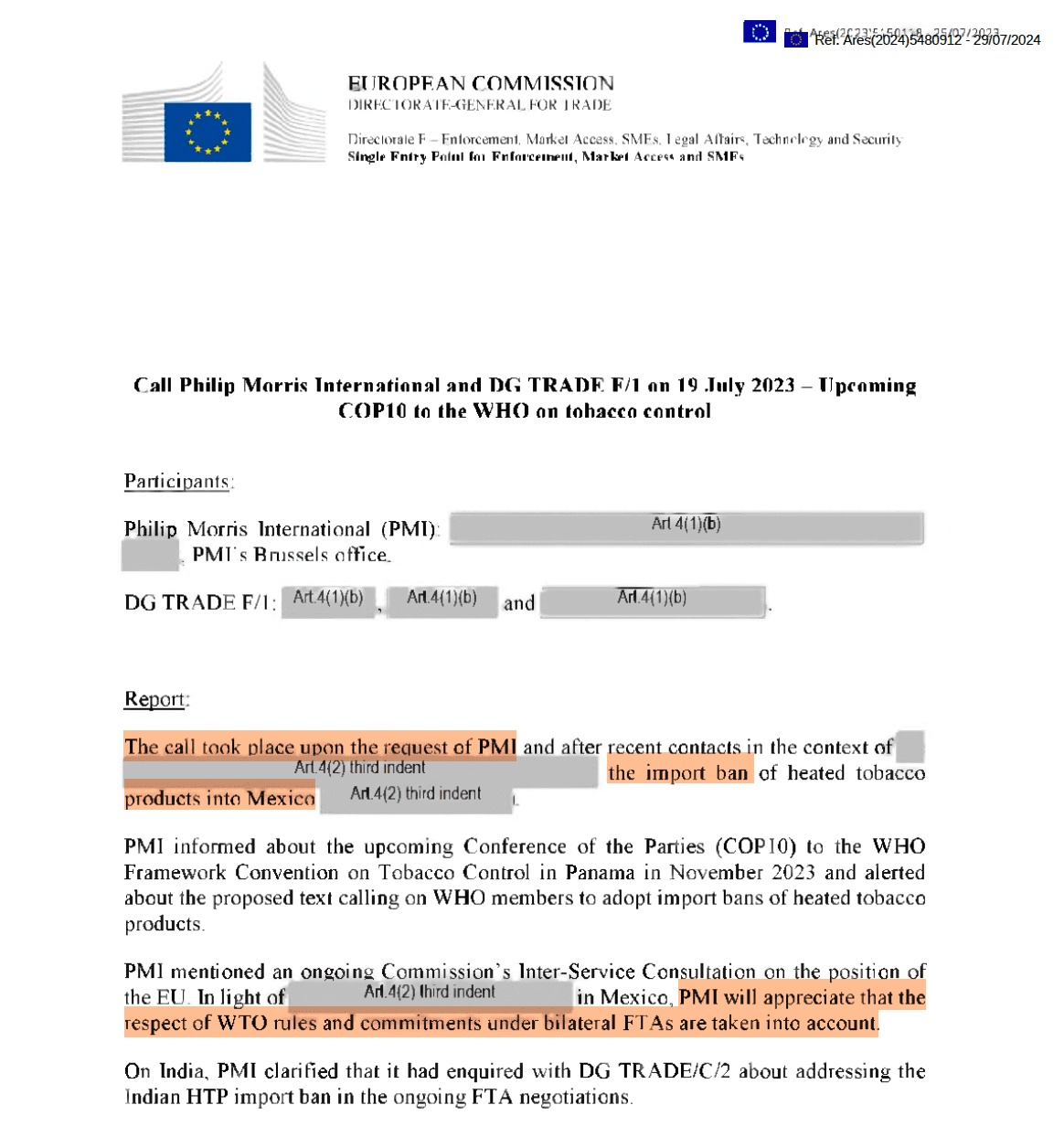
The documents don't say anything about whether the Commission took action, and tobacco-friendly countries in the EU such as Italy and Greece pushed back against restrictive guidelines. But in the end, the Commission took no position on heated tobacco— a victory for the industry.
During the period covered by the documents, the EU required only high-ranking Commission officials to report meetings with companies or special-interest groups. In December 2024, the Commission tightened rules to require disclosure by additional staff. It’s unclear whether those rules would’ve required disclosure of these meetings.
Former EU ombudsman, Emily O’Reilly, found other instances in which the Commission didn’t disclose meetings with the tobacco industry, which she concluded failed to meet transparency rules required under international law.
Contre-Feu has urged the EU to tighten transparency guidelines even further by extending disclosure requirements to all staff, among other things.
The group said in its report that the extensive lobbying and lack of disclosure “reveal either a repeated violation of the FCTC by the European Commission or, at the very least, an insufficient implementation of the treaty's measures.”
Mathieu Tourliere of Proceso contributed reporting.
STOP has received support from Bloomberg Philanthropies, which also provides financial support to The Examination. The Examination operates independently and is solely responsible for its content.
Correction: This story has been corrected to say that the report on tobacco industry lobbying was jointly published by Contre-Feu and STOP, and that STOP has received support from Bloomberg Philanthropies.