This investigation is part of a project reported in partnership with The Examination, The New York Times, Premium Times, ClassFM Online, Pambazuko and Truth Reporting Post.
Authorities in Togo are investigating lead contamination from battery recyclers for the first time after The Examination and the Togolese news outlet Truth Reporting Post documented dangerous levels of the toxic metal in soil and crops near homes and schools.
The ministry of environment in the West African country ordered a study by independent researchers to confirm results of tests commissioned by The Examination. Those tests, the first of their kind in Togo, showed that 14 of 21 soil samples near battery recycling factories had levels of lead considered unsafe under international standards.
The Examination’s testing was part of an investigation into African battery recyclers that supply lead for U.S. and European car batteries, poisoning people and contaminating soil in the process.
In Ogijo, Nigeria, testing commissioned by The Examination and The New York Times found dangerous levels of lead in dust and soil near a cluster of battery recyclers. Of 70 people who volunteered for blood testing, 70% had lead poisoning. More than 20,000 people live within a mile of those factories; based on the test results, experts said many of them probably have been poisoned.
Subscribe to our newsletter
Global health reporting, straight to your inbox
Scientists concluded that lead recyclers, which operated without legally required pollution control equipment, were the likely source.
Following the news outlets’ investigation, Nigerian officials closed seven recycling factories, conducted soil, air and water tests to confirm lead contamination and announced plans to test hundreds of people.
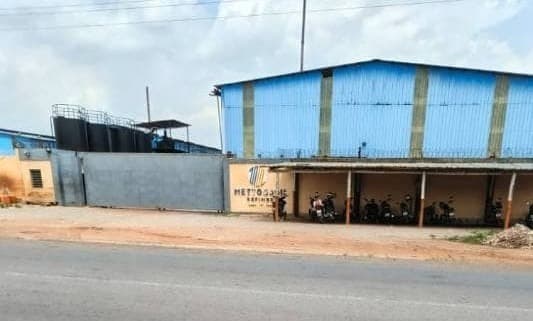
One hundred and fifty miles to the west in Togo, scientists hired by The Examination also discovered severe contamination. A pineapple sample had 6,400 times more lead than the United Nations' limit for that fruit. The highest levels were found at a landfill near Mettogo Recycling, a lead recycler near the agricultural village of Gati, which has about 4,000 residents.
Scientists concluded battery recyclers were the source of the contamination.
Aboudoulatif Diallo, a professor of toxicology at the Université de Lomé who oversaw the study in Togo, said the “alarming” lead levels posed a health risk to people living near and working in the factories. “Urgent action” was needed, according to his team’s report, including strict regulations, inspection of contaminated sites and public warnings of the health risks.

Kodjo Lazare Abgetossou, a corn farmer and father of three, complained about the emissions from the Mettogo factory.
“The air we used to breathe was very good, better than the air we breathe today,” said Agbetossou, 45. “The factory emits odors that are unbearable,” he said. “At night, it causes a coughing epidemic.”
Mettogo did not respond to requests for comment.
Abdel-Ganiou Soulemane, a senior official at Togo’s environmental management agency, said the study commissioned by The Examination was an important “warning sign” of lead exposure.
Inhaling or ingesting lead can cause headaches, stomachaches, seizures and permanent brain damage, especially in children.
“If we can say the soil is contaminated and if we can say it comes from a company, we will take measures,” said Soulemane, adding that he needed time to assess the government’s research before deciding whether to close or suspend any factory. Soulemane did not respond to repeated requests to provide results of the government testing.
Togo is one of several countries in Africa where battery recyclers have expanded in recent years.
Nearly all the lead recycled by African factories is exported for use by battery makers. Though industry representatives in the U.S. say most of the lead they use comes from North America, those manufacturers have increasingly relied on lead from a patchwork of unsafe, polluting factories overseas.
Meanwhile, the auto industry has rejected initiatives designed to reduce lead poisoning, The Examination and The Times found.
Though Togo is a relatively small producer of lead, its exports grew 17 times between 2023 and 2024, according to trade data. Mettogo shipped lead to metal traders in India that have supplied battery makers in Italy and Tunisia, trade records show.
Videos recorded inside the Mettogo factory and shared with Truth Reporting Post and The Examination show blazing furnaces and smoke rising to the ceiling, with practically nothing to capture the toxins.
Brian Wilson, who wrote a battery recycling manual for the United Nations and has inspected dozens of factories, reviewed the videos at the request of The Examination.
“Working conditions are appalling,” Wilson said. “I can only imagine the dust and fume generated during these operations.”
In a written statement, Soulemane, the environmental official, said his colleagues often visit Mettogo and recommend improvements. “The conditions of Mettogo employees are improving day by day,” Soulemane said.
The most recent visit took place in December, after Togolese authorities received a copy of the study commissioned by The Examination. During the visit, a nurse and the head of human resources at Mettogo distributed bottles of activated charcoal to workers, telling them that eating the charcoal would help remove lead from their bodies, according to two workers who were there and shared photos of the charcoal with The Examination.
“Nonsense, if not downright harmful,” said Mary Jean Brown, who served for years as the head of the lead poisoning prevention branch at the U.S. Centers for Disease Control and Prevention.
The two workers also said that the company recently tested several employees for lead, which they said was a first. Soulemane said such testing should occur regularly.
The workers who shared details of the visit with reporters asked not to be named, saying that Mettogo called police to the factory in December because an employee had shared videos of company operations. Police briefly detained him, the workers said.
“Cell phones are not allowed for factory workers and employees,” Bakana Kossi, head of personnel, told employees in a voice message obtained by Truth Reporting Post and shared with The Examination. “This is to address some issues in the factory that we are not handling properly.”
Alex Brutelle of The Examination and Pierre-Claver Kuvo of Truth Reporting Post contributed reporting.