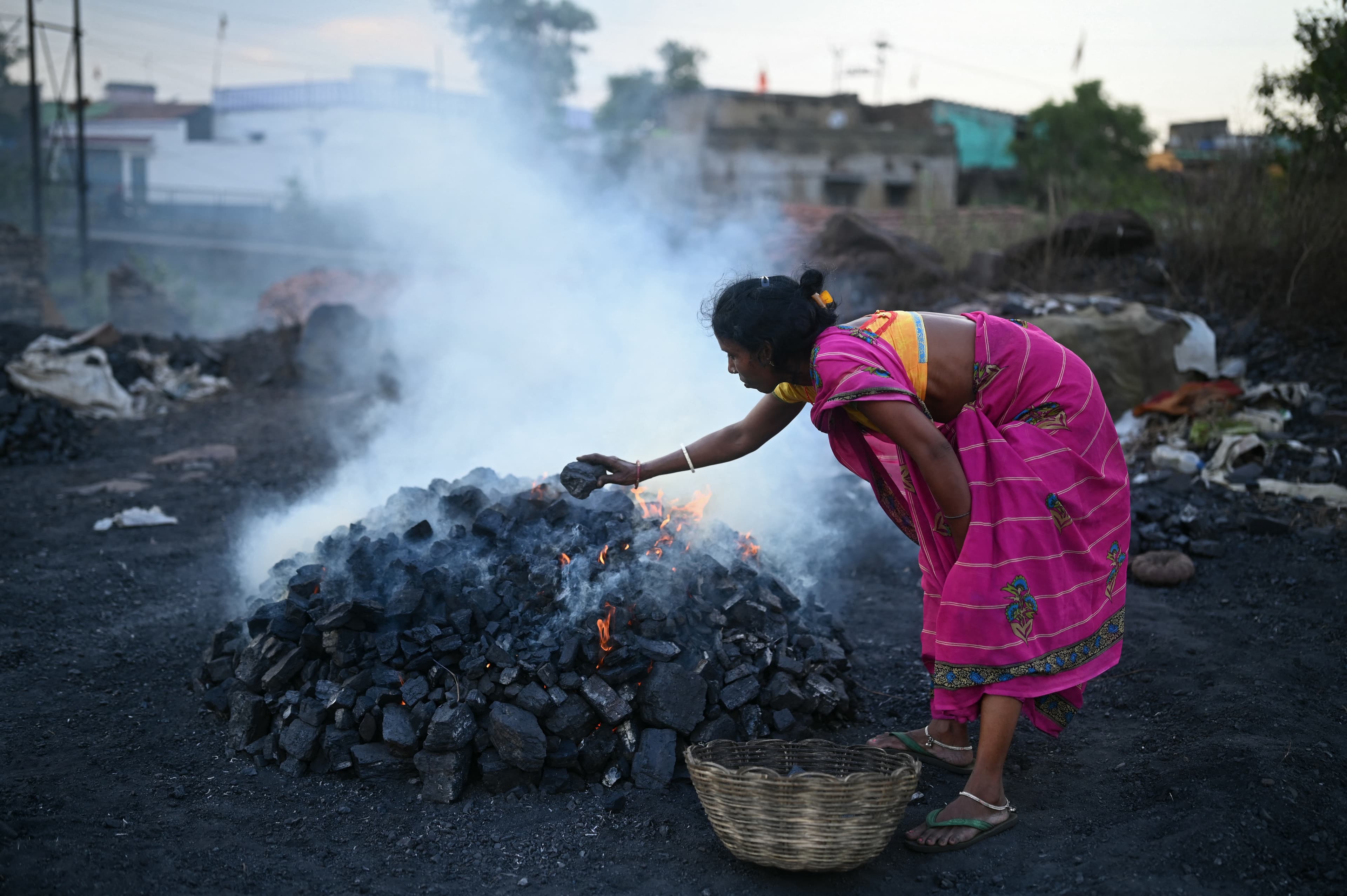
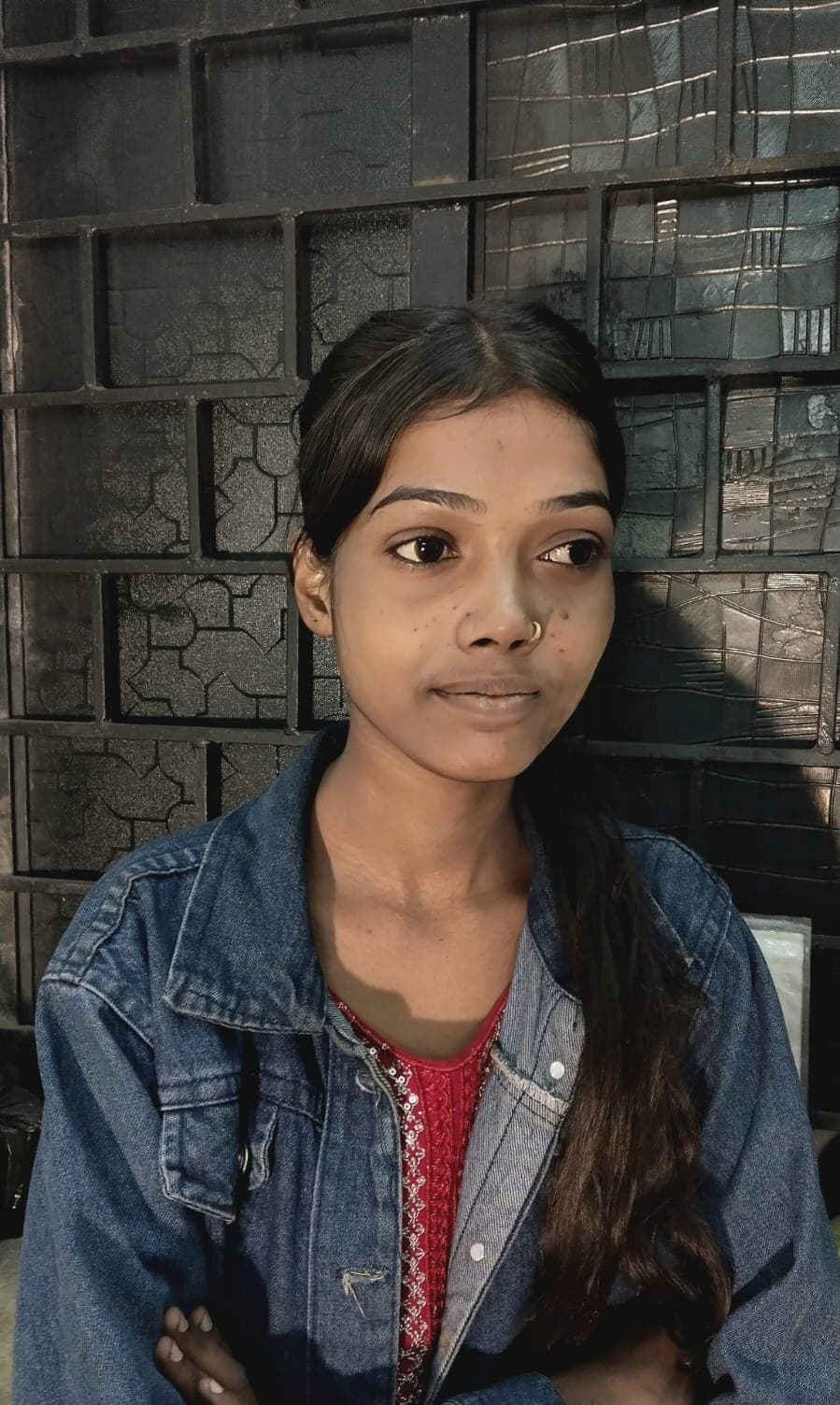
Several afternoons a week, 18-year-old Nandini Kumari attends her beloved arts program. It’s a welcome break from the rest of her days, when she accompanies her parents to the open-pit coal mines that surround Jharia, their small town in eastern India.
There, she hacks into coal blocks with a pickaxe, collects the chunks and sells them. This work has sustained her family, and countless others in this town, for generations.
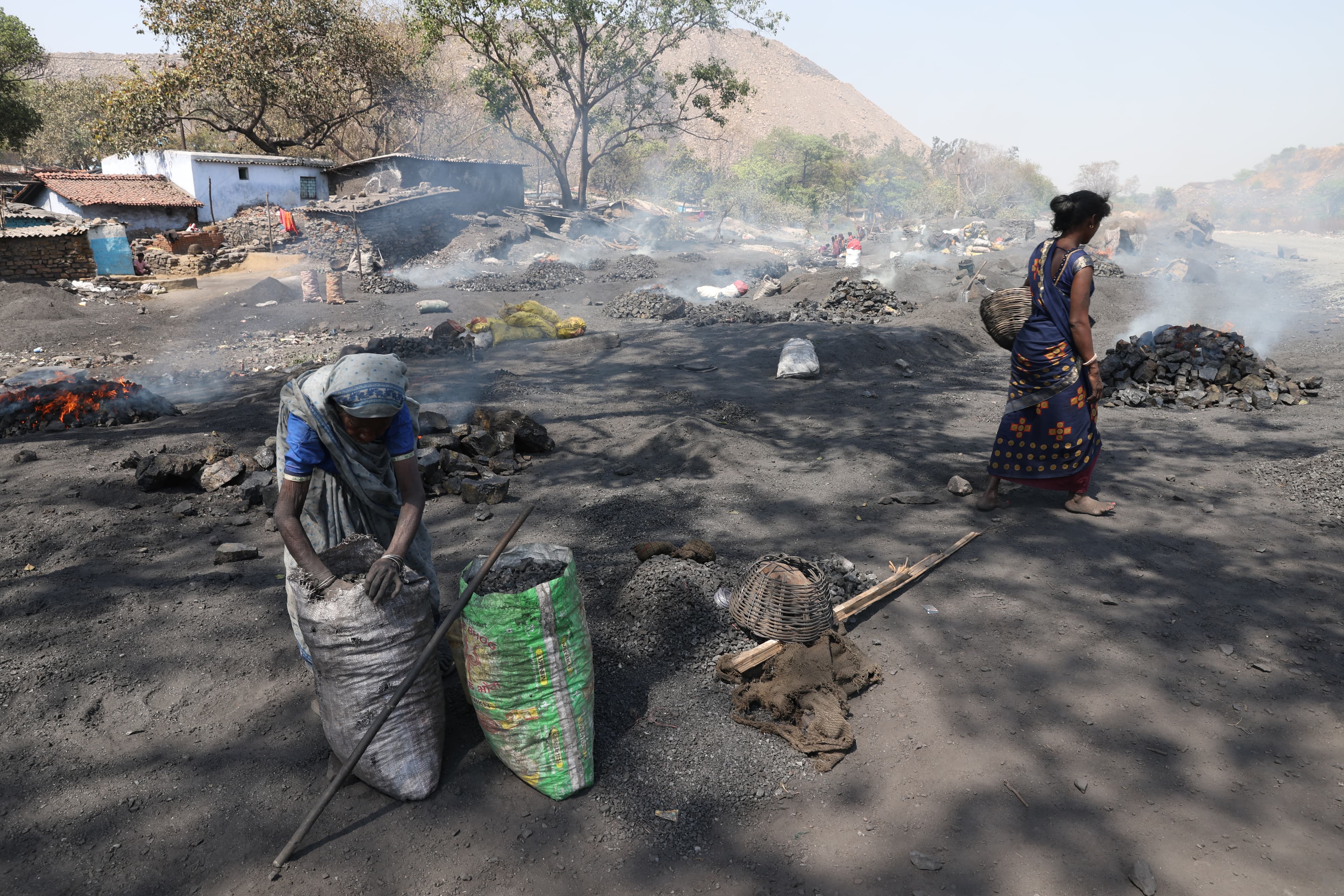
Open-pit coal mines are spread throughout Jharia, where machines dig through soil and rock to access coal seams close to the surface. Fires have burned in these coalfields for more than a century, some ignited when coal or embedded minerals interact with the oxygen in the air.
Occasionally, the burning ground caves in and swallows people; always, it spews smoke across the community. Today, this smog-filled town has the largest coal reserves in India, which is the world’s second-largest producer and consumer of coal.
Despite pledges by many countries to move away from coal, global demand remained at a record high in 2025 and is expected to be steady through 2030. In India and other regions driving that demand, communities such as Jharia are both helping to fuel the industry and suffering from its pollution.
India has committed to reach net-zero emissions of carbon dioxide and other greenhouse gases by 2070. But India also plans to increase its coal power capacity by 46% by 2035 to meet growing electricity demand, according to an analysis by the consulting company Wood Mackenzie. Worldwide, coal extraction and burning are among the leading causes of carbon dioxide emissions.
Experts fear this rapid increase will keep India hooked on coal and make life in Jharia and other coal-mining communities even more noxious. Already, the dust flying from open-pit mines and trucks hauling coal is so bad that Jharia is considered one of India’s most polluted communities, with the country’s highest concentration of coarse particulate matter, a leading cause of respiratory illnesses.
Most of the coal in India is mined by majority state-owned companies and sold to power producers and steelmakers. But there is also a substantial gray market for coal. People like Kumari collect small amounts from coal piles or open mines and sell to intermediaries, who in turn sell to small steelmakers.
46%
Projected growth in India’s coal power by 2035
The expansion of mining operations has brought more lorries that carry coal and spread toxic dust, and more families that scavenge for pieces of coal to sell.
Those families not only suffer from the pollution, they add to it. “Earlier there were coal cyclewalas,” or sellers on bicycles, “and now they are on motorbikes,” said professor Kuntala Lahiri Dutt, who runs the Resource, Environment and Development program at the Australian National University.
A survey carried out in 2024 by Vinoba Bhave University in Hazaribagh found that 19 people in 60 households surveyed in communities near the Jharia coalfields had tuberculosis, compared to two people in households farther from mines. Tuberculosis, a bacterial lung infection, is common in areas with poor air because pollution weakens the immune system.
People living near the coalfields had other medical problems as well: Fifteen had asthma, 35 had eye diseases, 38 had respiratory allergies and 16 had experienced miscarriages or given birth prematurely — far more than those who lived farther away.
Two years ago, Kumari’s mother and grandmother approached Pinaki Roy, who runs the Coalfield Children Classes arts program, asking for help. The frail teenager would cough all night, and the women were worried. Roy reached out to doctors he knew and Kumari was quickly diagnosed with tuberculosis.
While TB is usually cured in under a year, the treatment involves four antibiotics with side effects that can include vomiting, joint pain and skin rashes. Treatment can also cause liver damage, deafness and vision problems.
Kumari, who is still undergoing treatment, has lost weight and has dealt with nausea and tiredness. “I have to bear it.” she said.
Dr. Sanjoy Mukherjee, who diagnosed Kumari, said he regularly sees patients with collapsed lungs, lung scarring known as “coal miner’s lung,” also known as black lung, asthma and tuberculosis.
“They live in places with no sanitation, no water, no sunlight and dust flying around,” said Mukherjee, who works in nearby Dhanbad. “They are living on deathbeds. They should not be allowed to live here.”
Bharat Coking Coal Ltd., which owns most of the mines in the area, did not respond to The Examination’s emails seeking comment. The company is a subsidiary of Coal India Ltd., which is run by the Ministry of Coal and Mines. The ministry did not respond to requests for comment, either.
To meet demand, power companies rely on time-tested coal
With the expansion of coal power plants, including a recently announced 2,400-megawatt plant in the neighboring state of Bihar, mining is very much here to stay in towns like Jharia.
Behind this expansion are some of the country’s most powerful companies, such as Adani Group, Tata Power and the Torrent Group.
Adani Power, which is building the Bihar plant and others, will double the amount of coal it burns to 155 million metric tons annually, according to an analysis by the nonprofit AdaniWatch, which monitors the company. Adani did not respond to The Examination’s request for comment.
Tata Power plans to increase its coal power capacity for the first time in six years, tendering a bid last year to expand a plant in northern India, according to Reuters. And in August, the Torrent Group announced a 1.6-gigawatt coal plant in the central Indian state of Madhya Pradesh.
Subscribe to our newsletter
Global health reporting, straight to your inbox
Those announcements have been spurred by India’s rapid economic growth, said Duttatreya Das, an energy analyst at Ember, an energy policy think tank. India’s gross domestic product, a measure of the country’s economic activity, has grown more than 6.5% annually over the last four years and is projected to grow by more than 6.8% in 2027, according to government estimates.
Renewable power can cost half as much as coal power, and it’s far cleaner. But India has not built enough storage capacity for renewable power, making renewables less attractive to state utilities.
Meanwhile, coal producers offer state governments long-term contracts with a fixed price. Even if renewables are sometimes cheaper, their prices can vary.
As a result of such agreements, state governments rely on coal even though the industry offers workers few safeguards like protective equipment, said Manoj Kumar N, an air pollution and power sector analyst at the Centre for Research on Energy and Clean Air, a San Francisco-based research outfit that focuses on the health impacts of air pollution.
Bharat Coking Coal Ltd. was listed on the Indian stock exchange in January, though it remains majority government-owned. In listing documents, the company said that while its work is “inherently hazardous,” it has improved safety procedures and has reduced accidents.
In July, India’s central government scaled back a decade-old requirement that coal power plants install equipment to curtail emissions. Manoj Kumar N found that in New Delhi, one of the most polluted cities in the world, only 14 of its 36 power plants will have to install remediation equipment.
They are living on deathbeds. They should not be allowed to live here.
Dr. Sanjoy Mukherjee, who regularly treats people in Jharia with respiratory problems
Power plants’ compliance with other environmental standards is poor, said Bhavreen Kandhari, a New Delhi-based environmental activist. She said it’s nearly impossible to find out how much pollution each plant emits, even though they are legally obliged to make such information accessible.
“We run around trying to get information on emissions,” Kandhari said. “This information needs to be in the public domain, and we need independent regulators.”
Swapnil Mishra, a professor at the government-run Indian School of Mines in Dhanbad, said the university is working to modernize mining in the country. She called coal a “backup plan” to meet India’s energy needs.
The Indian government and Bharat Coking Coal have planted trees in Dhanbad and Jharia, which can reduce airborne particulate matter and toxins, she said. The Ministry of Coal and Mines is closing abandoned mines to avoid methane releases and fires.
Government plans to relocate families
With coal power expanding, the Indian government has taken steps to provide alternate jobs and homes away from the coal fires.
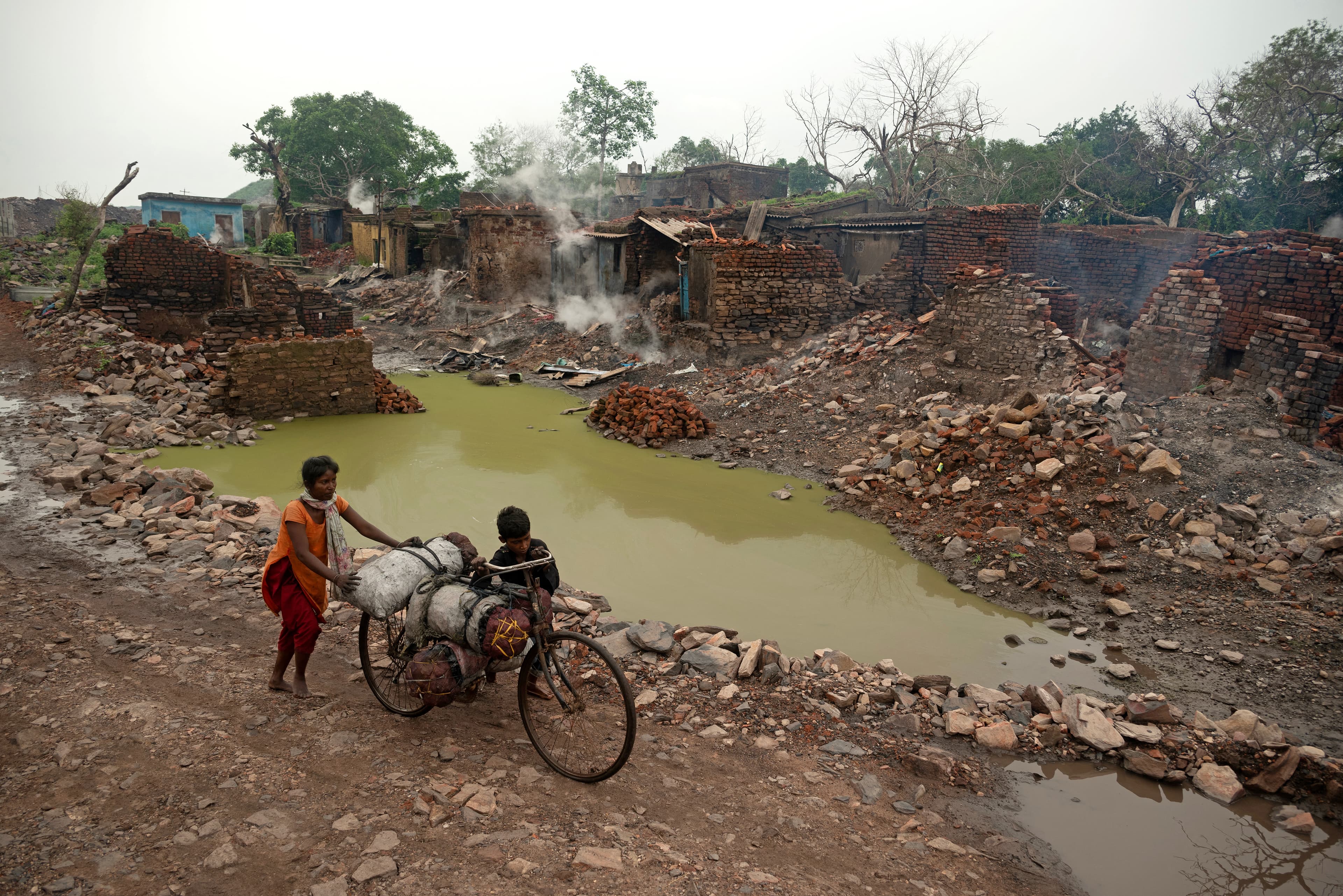
In June, the government approved a nearly $700 million rehabilitation plan, which aims to better manage coal fires and relocate people. More than 18,000 homes are being built away from mining sites, with promises of schools and subsidized food shops.
A small number of families have been given e-rickshaws — battery-powered, three-wheeled vehicles used to carry passengers or goods — to enable other ways to earn a living. A skills development center, which is under development, will offer vocational training.
But whether the government can shift homes and livelihoods away from these open-pit mines remains to be seen.
It’s been nearly three decades since the government began working to address coal fires and the subsidence they cause, and 15 years since the approval of a master plan that called for relocations and land remediation.
Since then, about two-thirds of the town’s fires have been extinguished.
But efforts to relocate Jharia residents have had limited success. A plan approved in 2009 resulted in about 2,200 families out of about 80,000 being relocated through 2021, according to researchers at Jawaharlal Nehru University. People who were relocated struggled to find jobs, reported Mongabay-India.
Meanwhile, more people settled in the Jharia coalfields, according to Mongabay-India.
What keeps them there, said residents and experts alike, is economic necessity. Children often drop out of school to help their families, making it hard for them to pursue a more promising future.
“This is a museum of poverty,” said Roy, who runs the community art program and helped find the doctor who diagnosed Kumari.
The teenager dreams of becoming a doctor or nurse. But even as she continues her TB treatment, she joins her family in the coalfields.
“I have to do it,” she said. There’s simply no other choice.