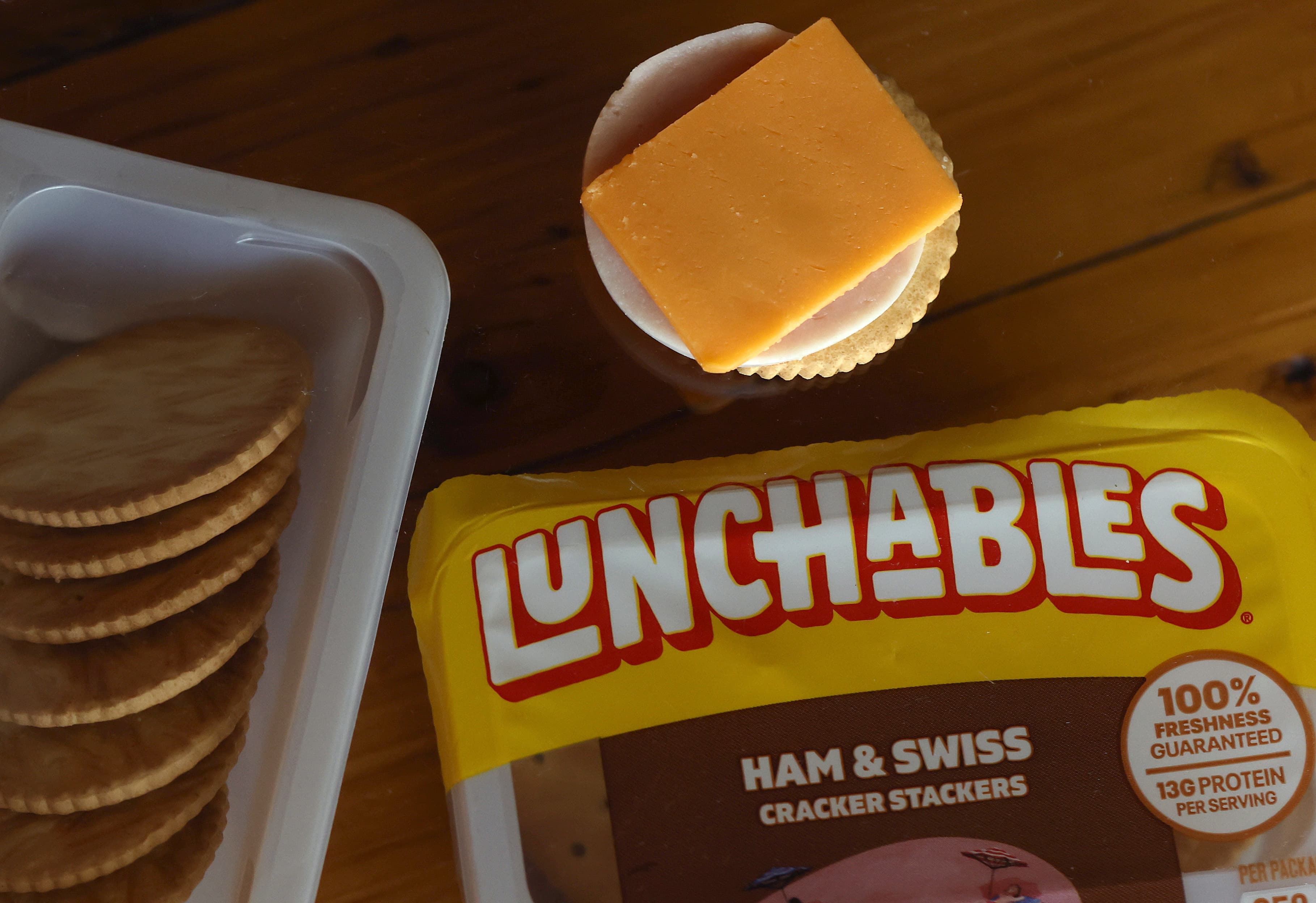
When Lunchables launched in 1989, it revolutionized kids’ meals. The yellow boxes of crackers, cheese and deli meat offered working moms an easy way to pack lunches and gave children a tangible DIY experience. Sales in the first year alone hit $200 million.
Its appeal was no accident, but rather the result of the ultraprocessed food industry’s adoption of tobacco marketing tactics, technologies, and behavioral science, according to research published last week in a special issue of the American Journal of Public Health.
After Philip Morris Companies acquired General Foods in the 1980s, it “applied its technical knowledge for making cigarettes” to Lunchables to bring it to market, writes author Laura Schmidt.
Her report, which draws on previously undisclosed company documents, adds to a body of research showing how Big Tobacco produced and marketed much of the unhealthy and addictive ultraprocessed foods saturating today’s food supply, including beloved products such as Oreos and Kraft Mac and Cheese.
Subscribe to our newsletter
Global health reporting, straight to your inbox
In response to the special issue, the Consumer Brands Association told The Examination that packaged food manufacturers adhere to government-established nutrition policy and “deliver safe, affordable and convenient products that consumers depend on every day.”
In a statement, Kraft Heinz, which currently owns Lunchables, said it has had no affiliation with Philip Morris since 2007 and now has a portfolio of “affordable options with more protein, more whole grains, less sugar and sodium, and no artificial dyes.” The tobacco company did not respond to requests for comment.
The Examination spoke about Big Tobacco’s ultraprocessed food legacy with Schmidt, a professor at the University of California, San Francisco, who has spent years studying that nexus.
This interview has been edited for clarity and length.
Your research draws on documents from the 1980s and ’90s. Kraft has said that they’ve long changed ownership and reformulated its product. Why does this matter today?
One of the most important features of Lunchables was this idea of using consumer-driven, cigarette-style product development where you embed consumer research into the actual engineering of the product.
They knew moms were feeling guilty and worried about the health impacts of giving their child a packaged food product. And so, they wrapped it up to make the packaging look like a gift. They made little transparent windows so moms could see the food. They made sure that there was a lot of familiar branding of existing Kraft cheese singles.
They also designed the product to look and feel like a toy. Both of those hallmarks of the tobacco product development strategy are still central to the brand today. In recent marketing by Kraft, it's all about showing children building little animals out of crackers and processed meat.
If the company has changed so much since it was owned by a tobacco company, why are they still using the product design features that were developed by the tobacco company?
I'm laughing because when I was a kid, I used to beg my mother to buy Lunchables.
It’s very intentional. Tobacco companies were beset with the idea of locking in children loyal to their brand. Why would they develop a cartoon character like Joe Camel to sell cigarettes when children can't even buy cigarettes? That is a really central feature of the tobacco business model that got transferred to the business model for ultraprocessed foods during the 1980s and ’90s.
If you can lock the consumer into your brand and lock out your competitor at age three or age five, then you don't have to compete as hard for that consumer for the rest of their life. Companies literally do calculations in their marketing divisions where they amortize how much money they save by locking you in at a younger age.
We know that ultraprocessed foods are linked to some pretty serious health issues, like cancer, diabetes and heart disease. But there are some people who may say it’s their personal choice to eat junk food. How do you respond to that?
It’s absolutely a personal choice and people should have a choice. The problem is that 70% of packaged foods in the grocery store are ultraprocessed. There is actually very little choice.
Companies intentionally create an illusion of choice so that they can absolve themselves of responsibility for limiting the ability of consumers to have a wide range of options based on health. Same with the front-of-package claims that it's healthy or natural.
We're talking about eight multinational food companies owning the global food supply. There's a profound lack of competition. And so the idea that we have choice, the idea that we have competition, is false. This is not a free market.
Subscribe to our newsletter
Global health reporting, straight to your inbox
What role do you see the government playing, if any?
Antitrust would be a first stop on the train. Breaking up these monopolistic companies that own huge proportions of the food supply and own the grocery stores would be a very smart move for lowering prices through competition and market mechanisms.
Then, I would go for our basic public health regulations that we know work. That includes taxing unhealthy products, putting front-of-package warning labels, restricting child-focused marketing, refusing to allow them to put cartoon characters on the front of packages.
These are all very well established, all well studied. We have over 70 countries around the world that tax soda. We have countries all over Latin America that put a warning label on ultraprocessed foods.
You note in your paper that U.S. lawsuits against tobacco companies in the 1990s helped lead to better regulation and a decrease in smoking. But Big Tobacco hasn’t gone anywhere and plenty of new products like vapes and pouches, which also have health risks, have since come to market. How do you think the food industry will respond to this moment?
Tobacco litigation worked hand-in-glove with regulatory strategies to dramatically lower rates of lung cancer in America, as well as cardiovascular disease. It was a massive public health success, and we should follow that as the blueprint for getting ourselves out of these commercially driven epidemics.
How will the industry respond? We already know how they're responding. They're very worried. They use lobbying and campaign donations to leverage lawmakers at higher levels of government to make it impossible for lawmakers at lower levels of government to protect public health.
The other strategy that they love to pull out is reformulation. The minute that people started to get worried about childhood obesity, Kraft was coming out with low-fat Lunchables because they were worried that they would lose market share as people became more wary of unhealthy food products. They reformulate to keep their market share stable.
They want us focused on the things that they can do to quickly reformulate, rather than to look at the whole picture and to look at the fact that when these foods came onto the market in the 1980s, we got a childhood obesity epidemic out of it and diseases of adulthood happening in children.
Given this elaborate ecosystem, do you have any advice for consumers to recognize these tactics and make informed decisions, or is it really beyond them?
It's very hard because they've saturated our food supply with this stuff. It's almost impossible to eat outside of the ultraprocessed foods business model.
I would advise people to turn the package around. The ingredients labels are not perfect by any means. But if you see anything that you don't recognize, that you don't have in your home kitchen, or anything that looks a little suspicious, don't buy the product.
What's tricky here is that companies have known for a long time that consumers are worried about this. And so, they develop labels that confuse the consumer by claiming something is natural. It makes it even harder for us to navigate the food system.
For those who have the time and the money, cooking at home with food that you can trust is probably your best option. But again, you know, that's asking a lot of people, and we shouldn't have to live in a food system where 70% of what we have in our grocery stores is suspicious.