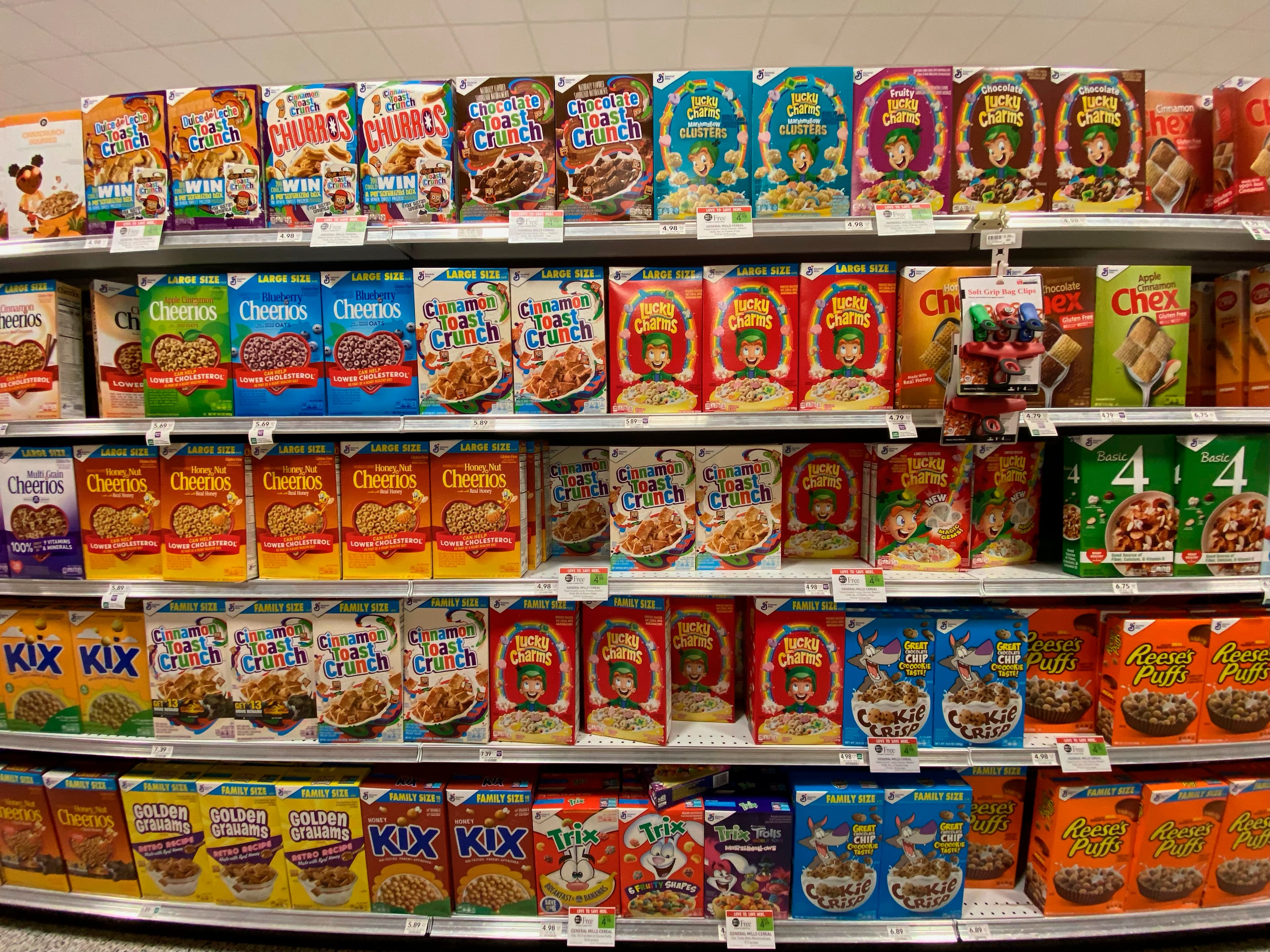
When I was a kid, I’d run straight to the cereal aisle, drawn in by vibrant boxes promising toys, games and morning joy. I begged for the packages with photos of strawberries on them, convinced there was real fruit inside. As a teen, when I wanted a “beach-ready body,” I fell for the “healthier,” slim-waist marketing on the box. I bought into every single promise.
It turns out these aren’t just benign childhood memories; they’re inadvertent recollections of the highly engineered marketing tactics designed by cereal companies.
In her latest book, “Sugar Coated,” renowned public health advocate Marion Nestle and co-author Lisa Sutherland — a former vice president of nutrition at Kellogg Company — trace cereal’s evolution from 19th-century sanitariums to today’s supermarket shelves. In the process, they pull back the curtain on the multibillion-dollar industry’s artificial dyes, aggressive claims and hidden lobbying.
I spoke with Nestle about the powerful, colorful deception sitting at our breakfast tables. The interview has been edited for clarity and length. Kellogg did not respond to a request for comment.
Subscribe to our newsletter
Global health reporting, straight to your inbox
How did the food industry popularize the idea that cereal is an essential breakfast food?
The industry funded studies showing that people who ate breakfast were healthier than people who didn't, and that people who ate cereal were healthier than those who didn't. That’s why you fund researchers — to get results like that.
There have been other studies that say breakfast is not the most important meal of the day: it's what you eat, not when, that matters. And there certainly are studies that say that there are plenty of other things that are healthy for breakfast. But that's how it happened. Nutritionists bought into it and told their clients that breakfast was really important and yelled at people who didn't eat breakfast.
I'm not a breakfast eater, you can tell. And I've given lectures where I've confessed to not eating breakfast and people have come up to me afterwards with tears in their eyes because they're so grateful.
You cite a study in your book that found children eat at least 10 pounds of sugar a year from cereal alone. How did sugary cereal become okay for kids to eat?
Again, that was cereal industry marketing. The industry said, ‘You know, kids don't like to drink milk, this is a way to get kids to drink milk.’ Kids could get up and pull a box from a shelf, put it in a bowl, add milk, and didn't have to wake up their parents. They could do it themselves.
The industry also did things to attract children to cereals. They advertised on Saturday morning television, which all kids watched in that era. And they put games on the box or toys in the box. This was brilliant marketing.
You can argue, ‘Well, kids don't have any money of their own so why were cereal companies marketing directly to kids?’ If you've ever seen a kid in the cereal aisle, you know the answer. This is a product made just for them. The objective is to get kids to think that they know more about what they're supposed to eat than their parents do and pester their parents to buy it.
One of the core issues you cover is the struggle between cereal companies and government regulators like the U.S. Food and Drug Administration. What’s the most striking dispute you came across in your research?
The big one was Kellogg breaking the FDA's restrictions on marketing health claims. The FDA argued that if a food label claimed it prevented, mitigated or treated a disease, it was positioning itself as a drug. And if it did that, it had to prove safety and efficacy. Well, if you give it a moment's thought, you know that proving breakfast cereal prevents heart disease is ridiculous.
In 1984, Kellogg went to the National Cancer Institute and partnered with them to put a claim about fiber and colon cancer on boxes. Once that happened, there was no going back. Kellogg hadn’t discussed it with the FDA, and its officials were appalled. But the National Cancer Institute was thrilled. They thought, ‘Yay, we're going to get the message about fiber and cancer out to millions of people we wouldn't have been able to reach otherwise.’
The FDA couldn't do anything about it and there was enormous back and forth. In 1994, Congress passed an act that permitted dietary supplements to use a different kind of claim called a structure/function claim: they could say a supplement supported a healthy heart, but not that a supplement prevented heart disease.
Food companies said if supplements can use those claims, they should be able to, too. When the FDA said no, they took the FDA to court until the FDA said they weren't going to fight them anymore.
So now food products can use structure/function claims and the FDA can't do a thing about it. That explains the immunity claim on Kellogg cereal, the one about cognitive function in kids, the antioxidant claims, those kinds of things.
You outline various ways of how the industry uses health claims to sell their products. What is the best example of this?
Cheerios has a banner on it that says, “lowers cholesterol” in very big letters. If you look very closely at the package, it also says, “if consumed as part of a healthy diet” in very small letters. You see that on most Cheerios products.
The last new health claim that we saw was the sleep claim — a cereal saying it supports healthy melatonin production and helps you sleep. The idea there was to try to get people to eat cereal at bedtime, to increase the number of times a day people eat cereal. That box didn't last very long. I haven't seen it recently, I don't think people bought it. And the health claims have kind of quieted down.
For kids' cereal, the big thing now is the industry taking out artificial additives, but that doesn't really make much difference to the quality of the cereal.
My current favorite cereal, because I think it's so funny, is Cookies & Cream Cheerios Protein, which has pea protein added, isolated pea protein. All you can do is laugh. I think if you want protein, eat peas.
The food industry has swapped sugar for honey and has added vitamins, and even protein, to be part of the latest health trends. Is there any real science at work here?
The science is very clear: they don't make any difference at all. It's one food, and what matters to health is the entire diet. If you eat a completely healthy diet and also eat sugary breakfast cereal, it's not going to make a difference. If all you're eating is junk food, it just adds to the junk food you're eating.
The only reason for doing all this is to try to get people to buy that product. It's about marketing, not about health or science. They'll do anything they can get away with.
What do you most want readers to take away about the food industry from this book?
That everything is about marketing. Absolutely everything. Food companies market their products not only through advertising and beautiful boxes and wonderful cartoons and bright colors and terrific games, but also through lobbying and fighting lawsuits behind the scenes. It's all part of how marketing works. “Sugar Coated” is really a book about how food marketing works, using cereal boxes as an example — a very good example.
Cereal companies are very powerful, though I don't know how long that'll last. Kellogg split a couple of years ago and was bought by candy companies. I thought that was pretty funny. Ferrero and Mars now own cereals. I'm expecting to see lots of candy-supplemented cereals. We're going to have Nutella cereal pretty soon!
You point out all the ways the U.S. — the birthplace of cereal — falls short on regulations. Are there any countries getting this right?
Latin American countries are really leading the way on this, starting with Brazil and Chile. Six or seven Latin American countries now have warning labels on foods that are ultraprocessed or high in fat, sugar, salt, calories or artificial sweeteners. The boxes from these countries are amazing to see.
I've been to Mexico and seen what the companies do to try to get around the warning labels, like turning boxes around so the fronts don't show or pasting funny labels over them. But those countries are worried about childhood obesity and want to prevent it. They're doing package labeling, marketing restrictions and school food restrictions. They’re looking at a number of policies that might help people make healthier food choices.
If you want people to make healthier food choices, you have to regulate the food industry, but that's pretty tough.
Consumers want more transparency and information is more accessible than ever — but companies seem to keep finding a way to push back against tighter regulation. Given what you know about the food industry and the history of cereal, do you think real change is possible?
Well, we need a system change.
If we had leaders in government who cared about public health, I think things would change. But until we get money out of politics, tax the rich and have an agricultural system that's focused on food — not feed for animals and fuel for automobiles — it's going to be very hard to make those changes.
But those changes are worth working toward. And if you have a pretty good idea of what you know needs to be changed and are working toward it, I think that's a good way to spend time.