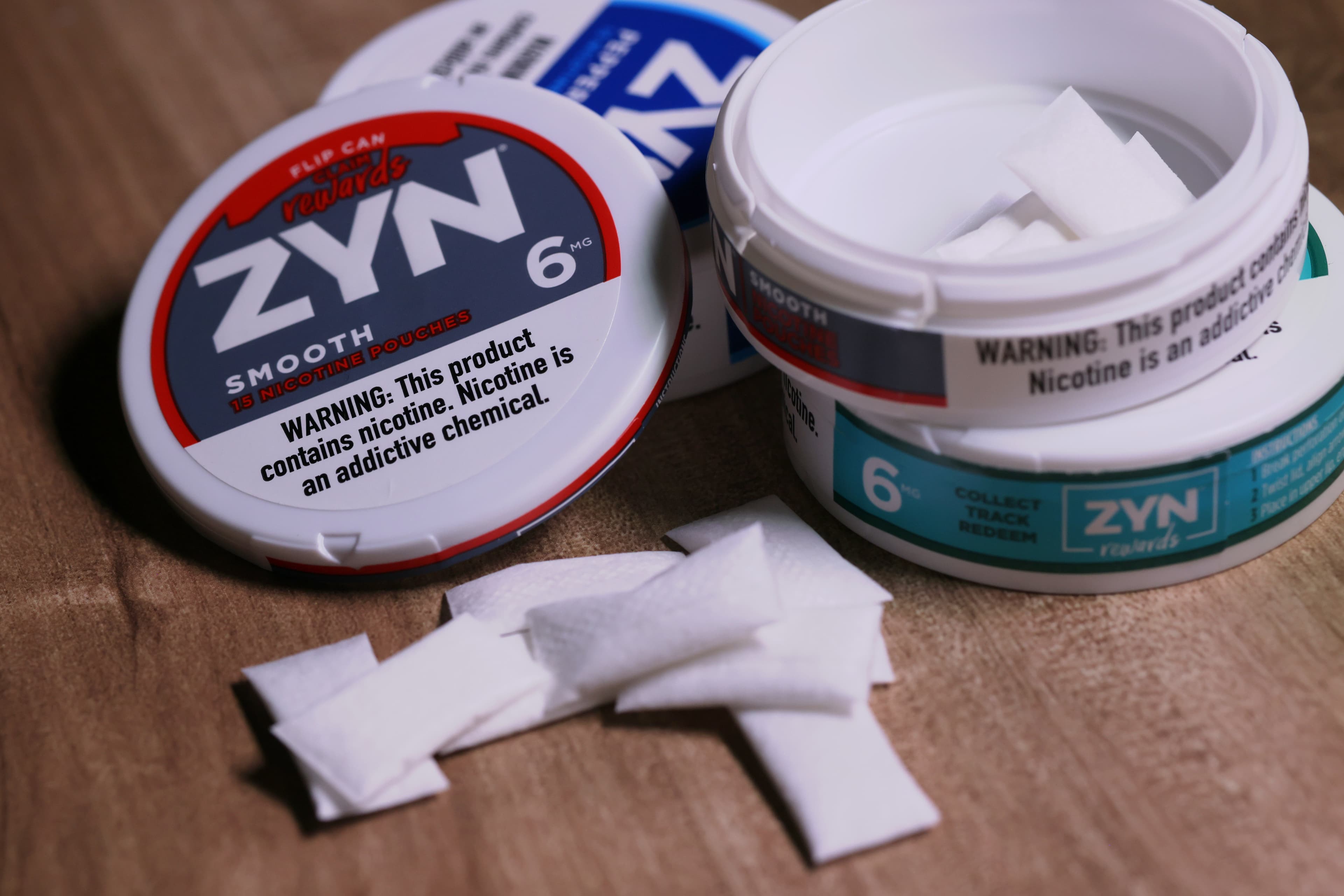
The tobacco industry has turned to nicotine pouches to help it build a business beyond cigarettes. They’ve soared in popularity in recent years, with U.S. sales reaching an estimated $6.2 billion in 2025, more than doubling since 2023, according to the CDC Foundation.
The U.S. Food and Drug Administration has authorized two products, Philip Morris International’s ZYN and Altria’s on! PLUS, saying they provide smokers with a less harmful option than cigarettes. The government has allowed many other brands, including British American Tobacco’s VELO pouches, to be sold while their FDA applications are pending.
Yet there’s no clear answer to the central question about nicotine pouches: Do their public health benefits for adult smokers outweigh the risk that a new generation of teenagers will become hooked on nicotine?
Answering that requires evidence on two fronts: whether adults use pouches to quit smoking or cut down on tobacco, and their popularity among youth.
New data from three long-term federal studies or surveys — the Population Assessment of Tobacco and Health Study, Monitoring the Future and the National Youth Tobacco Survey — shed light on both questions. Here’s what we know from those studies and others.
Are nicotine pouches less harmful than cigarettes?
The dangers of cigarettes have been known for decades. Smoking is the leading cause of preventable deaths globally, with more than 7 million people dying of smoking-related diseases each year, according to the World Health Organization.
Nicotine pouches — small packets of nicotine powder and flavorings that users tuck between the gum and lip — are generally thought to be much safer than cigarettes because users do not inhale cancer-causing toxins. However, research on pouches is limited, and their potential long-term health harms are not fully understood.
Nicotine is not harmless. It is an addictive chemical. The FDA’s review of one nicotine pouch brand said that long-term nicotine exposure has been linked to cardiovascular issues, among other health problems, and that nicotine use by young people can impact brain development.
But the FDA authorized ZYN pouches in January 2025 in part on the basis that they are less harmful than cigarettes.
The agency, however, said it could revoke its authorization if evidence emerged that more children and young people were using ZYN or if fewer adults switched to pouches to stop smoking.
Can nicotine pouches help smokers quit?
The tobacco industry and some public health officials argue that nicotine pouches can help smokers kick the habit.
As part of its application to the FDA, Philip Morris International submitted a study to support its claim that ZYN products helped a large number of smokers quit cigarettes.
The agency agreed — to a point. It said that the company’s evidence did show that adults who completely switched from cigarettes to pouches benefited.
But reviewers questioned the study’s conclusion that 24% of new pouch users quit other tobacco products, noting that many people quit the study before it was over. The proportion of people who would completely switch to pouches is “expected to be modest,” FDA reviewers wrote.
Philip Morris International did not respond to a question about the FDA’s conclusion on its study.
The idea that people are using pouches to quit smoking has not yet been borne out in the data. A 2025 Cochrane review, considered the gold standard in medicine evidence reviews, found that there was “limited available” evidence pouches helped users quit or smoke fewer cigarettes.
Subscribe to our newsletter
Global health reporting, straight to your inbox
The Population Assessment of Tobacco and Health Study, run by the National Institutes of Health and the FDA, has tracked tobacco and nicotine use among the same group of adults and young people since 2013.
According to the latest study, which goes through 2024, less than 1% of smokers 18 and older had switched completely from cigarettes to pouches. Just 2.2% had shifted from cigarettes and similar products to a mix of pouches and cigarettes. (That data doesn’t cover any of the period following the FDA’s authorization, after which sales jumped.)
Andrew Hyland, the principal investigator of that study, said that means pouches are not widely used by smokers and that “fewer still are switching completely away from combustibles to nicotine pouches.” He said more research needs to be done to track whether people are using pouches to quit smoking.
But Luz M. Sanchez-Romero, an assistant professor studying tobacco at Georgetown University’s Lombardi Comprehensive Cancer Center, is optimistic about the potential benefits of nicotine pouches for adults looking to stop smoking.
“We see that some cigarette users are moving to dual use with nicotine pouches,” which might be a step on the way to quitting cigarettes and exclusively using pouches, she said.
Philip Morris International did not respond to requests for comment about the Population Assessment of Tobacco and Health Study’s finding on use of pouches to quit smoking.
British American Tobacco and Altria did not respond to the Examination’s requests for comment.
On its website, Altria states that “nicotine pouches provide a smoke-free alternative for adults seeking to transition away from cigarettes.”
British American Tobacco states on its website that “products like VELO can play an important role in offering smokers satisfactory, complete alternatives to continued cigarette smoking.”
How popular are nicotine pouches with young people?
Only people aged 21 or above can legally buy nicotine pouches in the U.S. Research shows teenagers are using them, but use is fairly low so far.
The National Youth Tobacco Survey, now run by the FDA, polls middle- and high-school students annually. It found that the percentage of high-school students (typically aged 14 to 18) who reported using pouches in the prior 30 days remained relatively steady from 2024 to 2025, going from 2.4% to 2.3%.
Use among older teenagers appears to be higher. The annual Monitoring The Future survey found that the percentage of 12th graders (typically 17 to 18 years old) who reported using pouches in the prior 30 days rose from 2024 to 2025, from 3.5% to 4.4%. The survey also found an increase in older teenagers who reported using the pouches in the prior year.
Richard Miech, the principal investigator for Monitoring The Future, said the figures on youth use warrant close monitoring.
Data from Sweden paints a cautionary picture, he said. Nicotine pouches were introduced in Sweden in 2016; snus, a similar product made of moist, ground tobacco, has been sold there since the 17th century. Both products are used widely by young people.
A 2025 survey by the Swedish Council for Information on Alcohol and Other Drugs found that 27% of 18- to 19-year-olds and 14% of 15- to 16-year-olds reported using one or the other, with adolescents predominantly reaching for nicotine pouches.
Tobacco companies don’t mention high use among Swedish youth in their presentations, instead citing Swedish studies showing adult smokers in the country used the pouches to quit cigarettes.
Philip Morris International did not respond to a question about the Swedish study.
Could nicotine pouches become as popular among young people as vapes?
Nicotine pouches are much less popular among young people than e-cigarettes right now, but sweet, fruit and mint flavors of both products are particularly appealing to youth. Use of vapes among high school students soared to nearly 28% in 2019 after the U.S. Surgeon General declared teen vaping an “epidemic.” Usage has since declined; more than 7% of high school students reported vaping in 2025.
Researchers are watching for signs of a similar jump in teenage nicotine pouch use. One sign is awareness of different types of nicotine products, a possible precursor to using them.
The data from the Population Assessment of Tobacco and Health Study shows awareness of nicotine pouches rising among teenagers and young adults. Those age groups are more aware of these products than adults over 25. Among 12- to 17-year-olds, awareness jumped from about 25% to about 37% between 2024 and 2025. Among those ages 12 to 24 who were aware of nicotine pouches in 2024, a quarter said they were open to trying them in the future.
Clinical psychologist Benjamin Toll, who runs a South Carolina treatment center for those looking to stop smoking and vaping, said it was “troubling” that more teenagers and young people were aware of nicotine pouches than adults and blamed tobacco industry marketing.
A spokesperson for Philip Morris International said the recent national U.S. surveys showed that “youth use of nicotine pouches remains low and stable over time” and that this is the most meaningful thing to measure for public health.
But Lauren Czaplicki, associate scientist at the Institute for Global Tobacco Control at Johns Hopkins Bloomberg School of Public Health, said, “It should concern us all that there's even any proportion of youth underage using these products.”
She said regulators, researchers and public health officials should ask, “What are the measures that we know are proven to stop the appeal of these products to kids? It's really restricting appealing flavors and reducing the marketing tactics that we know appeal to kids."
Johns Hopkins Bloomberg School of Public Health has received support from Bloomberg Philanthropies, which also provides financial support to The Examination. The Examination operates independently and is solely responsible for its content.